
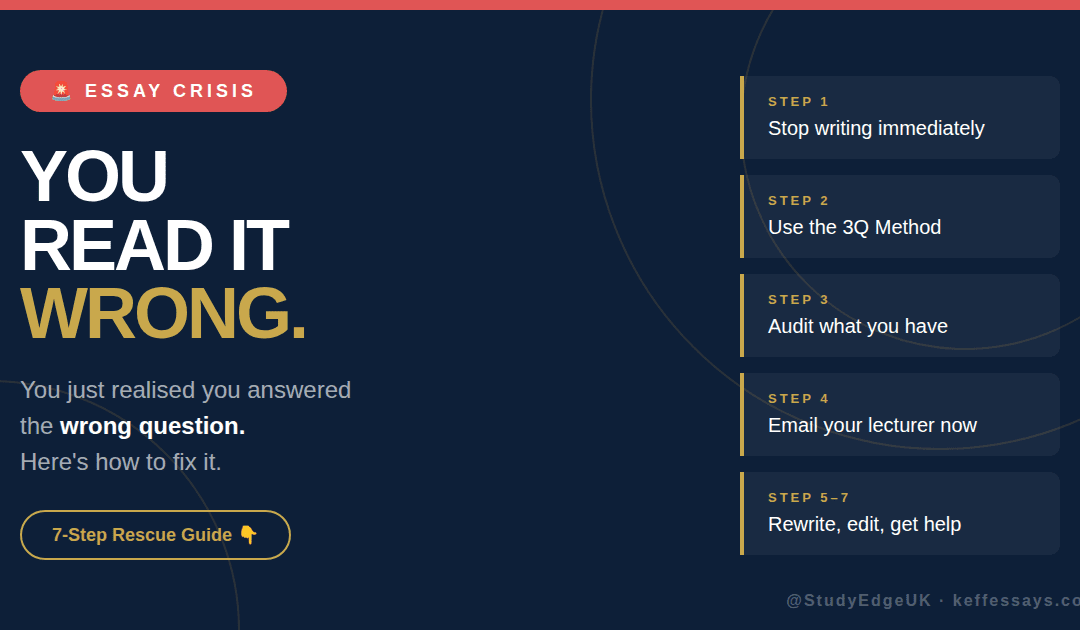
Your stomach just dropped. You re-read the essay prompt for the first time in days — really read it — and you have realised with cold clarity that what you have been writing for the last week answers an entirely different question. The deadline is tomorrow. You have 2,000 words of completely wrong content sitting in a document in front of you. If you have ever experienced that specific, ice-water panic — or if you are experiencing it right now — this guide is written for you.
Misinterpreting a university essay prompt is one of the most common academic mistakes UK and US students make. It happens at every level, in every subject, at every university. The good news is that it is recoverable. What to do if you misinterpreted your university essay prompt deadline is a solvable problem — and the 7 steps below will walk you through exactly how to turn the situation around faster than you think is possible.
What to do if you misinterpreted your university essay prompt and why it happens
Understanding why this happens is not just reassuring — it is useful. When you know the root cause, you can apply the right fix. The most common reasons UK and US students misinterpret essay prompts are:
- Reading for confirmation rather than instruction. Most students read a prompt once, form a rough idea of what they think it is asking, and immediately start writing. Any details that contradict their assumption get mentally filtered out.
- Focusing on the topic instead of the task word. Essay prompts contain two things: a topic and a task word. The topic is what the essay is about. The task word — analyse, evaluate, compare, discuss — is what you are being asked to do with it. Students consistently identify the topic correctly and misread the task word entirely.
- Ambiguous phrasing in the prompt itself. Some prompts are genuinely ambiguous. This is not your failure — it is a communication issue. The solution to this is in Step 4 of this guide.
- Time pressure causing shallow reading. The more rushed you are, the more carefully you actually need to read the prompt — which is counterintuitive but consistently true.
How Serious Is It? — The Three Situations
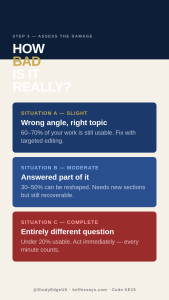
The severity depends on one thing: how far off-track your current work is from what the prompt actually asks. There are three possible situations you might be in right now.
The 3-Question Method in Step 2 will tell you exactly which situation applies to you.
Step 1 — Stop Writing Immediately
This sounds obvious but it is the step most students skip. They know something is wrong but they keep writing — either hoping it will somehow come together, or because stopping feels like giving up. Continuing to write in the wrong direction after you have realised your error does one thing: it makes the problem larger. Every additional word you write incorrectly is another word you will need to cut or rewrite. Stop. Close the document. Open a new blank document. Before you write another single word, you need to fully understand what the prompt is actually asking you. That starts with Step 2.
Step 2 — Re-Read the Prompt Using the 3-Question Method
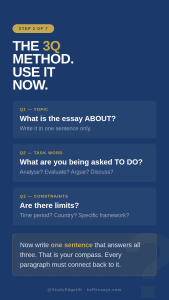
Open a fresh document and paste your essay prompt at the top. Then answer these three questions in writing — do not just think through them, physically write your answers:
- What is the TOPIC? What subject area, concept, event, or phenomenon is this essay about? Write a one-sentence answer.
- What is the TASK WORD? What action word or instruction is the prompt using? Common task words in UK university essays include:
- Analyse — break the topic into components and examine each one
- Evaluate — assess the strengths, weaknesses, and overall significance
- Critically assess — make a judgement supported by evidence, acknowledging counterarguments
- Compare and contrast — identify similarities and differences between two or more things
- Discuss — examine multiple perspectives without necessarily reaching a definitive conclusion
- Argue — take a clear position and defend it with evidence
- Explain — make something clear and accessible, showing how or why it works
- What are the KEY CONSTRAINTS? Are there specific time periods, geographical areas, theoretical frameworks, or perspectives required? Write them all down.
Once you have answered all three questions, write a one-sentence summary of what the essay is actually asking you to do. This sentence is your compass for everything that follows. For a deeper breakdown of academic task words and what each one demands, Purdue OWL is the most comprehensive free academic writing resource available to university students.
Step 3 — Assess How Far Off You Actually Are
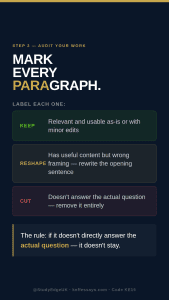
Go back to your existing work and read it with your one-sentence compass from Step 2 in front of you. For each paragraph, ask: does this paragraph contribute to answering the actual question? Mark each paragraph with one of three labels:
- KEEP — this paragraph is relevant and usable as-is or with minor edits.
- RESHAPE — this paragraph contains relevant material but needs reframing, a new opening sentence, or a different analytical angle.
- CUT — this paragraph does not contribute to the actual question and cannot be salvaged.
Be ruthless with your assessment. A paragraph that vaguely relates to the topic but does not address the task word is not a KEEP — it is a RESHAPE at best, and often a CUT. Most students in Situation A find 60–70% of their work is salvageable. Students in Situation B typically find 30–50% is usable. Students in Situation C often find 10–20% can be repurposed.
Step 4 — Email Your Lecturer Right Now
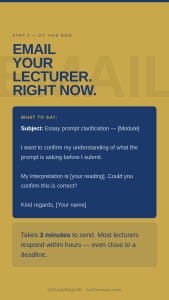
This is the step most students are afraid to take — and the one that can make the biggest difference. Email your lecturer or module convenor immediately. Do this before you do any more writing. Here is exactly what to say:
This email does three things simultaneously. It tells your lecturer you are engaged and taking the assignment seriously. It gives them the opportunity to correct your misunderstanding before submission. And if the prompt is genuinely ambiguous, it creates a paper trail that may protect you if your interpretation is questioned later. Most lecturers will respond within a few hours, even close to a deadline. The email takes three minutes to send. Send it now. Understanding your university’s academic expectations is just as important as writing the essay itself. UCAS contains guidance on what UK universities expect from students at every stage of their academic journey.
Step 5 — Build Your Fast Rewrite Plan
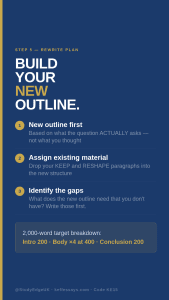
With your KEEP/RESHAPE/CUT audit complete and your email sent, build your rewrite plan in this order:
- Write a new outline based on the actual question. Your outline should answer the question directly at every level — introduction, each body paragraph, and conclusion should all visibly connect to the actual task word.
- Assign your existing material to the new outline. Where does your KEEP material fit? Where does your RESHAPE material fit with modification? Be realistic — some material that felt valuable in your original version will not fit the correct structure at all.
- Identify the genuine gaps. What does your new outline require that your existing material cannot provide? These are the sections you need to write from scratch. Write them first, while your energy is highest.
Word count allocation for a 2,000-word essay under time pressure:
- Introduction: 150–200 words
- Body paragraph 1: 350–400 words
- Body paragraph 2: 350–400 words
- Body paragraph 3: 350–400 words
- Body paragraph 4: 350–400 words
- Conclusion: 150–200 words
Each body paragraph follows the same internal structure: claim → evidence → analysis → link back to the question. The QAA Subject Benchmark Statements outline the expected level of analytical thinking for your degree level — understanding this helps you calibrate exactly what your rewritten essay needs to demonstrate.
Step 6 — What to Keep and What to Cut
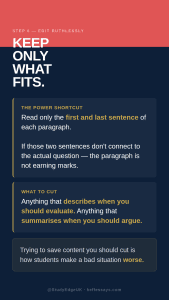
The editing phase is where students most commonly make the situation worse by trying to save content they should cut. The rule is simple: if it does not directly answer the actual question, it does not stay.
- What to keep without modification: Any paragraph that directly addresses the task word and provides evidence for a relevant argument. These require no new work.
- What to reshape: Paragraphs that contain relevant evidence but frame it incorrectly. Often the body of a paragraph is sound — it just needs its first and last sentences rewritten to align with the correct analytical direction.
- What to cut completely: Any paragraph that describes when the task was to evaluate, summarises when the task was to argue, or addresses a question that was never asked. Do not try to work these into your new structure.
One powerful shortcut: read only the first and last sentence of each body paragraph. If those two sentences do not clearly connect to the actual question, the paragraph is not earning its marks regardless of what is in the middle.
Step 7 — When You Are Too Far Gone to Fix It Alone
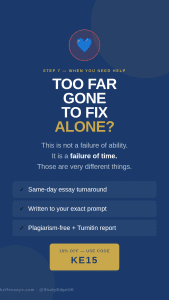
Sometimes the honest answer is that the gap between where you are and where you need to be is too large to close alone before the deadline. This is not a failure of ability — it is a failure of time. Those are very different things. If your deadline is within hours, you have a complete misinterpretation on your hands, and you have worked through Steps 1–6 and established that the rewrite required exceeds the time available, then professional academic support exists exactly for this situation.
If the stress of this deadline is becoming genuinely overwhelming — beyond just the essay — Student Minds provides free mental health resources specifically for UK university students. Your wellbeing matters more than any grade. keffessays.com has UK and US university-trained writers available right now who specialise in fast turnaround academic work. Every piece of work is original, plagiarism-free, and includes a Turnitin report.
If you need a rescue essay written to the correct prompt tonight, visit keffessays.com and use code KE15 for 15% off your first order. You came to this page because you are trying to solve this problem. That instinct — to keep working until you find a solution — is exactly the right one. Sometimes the solution is to ask for help. 💙
What to do if you misinterpreted your university essay prompt and how to avoid in the future
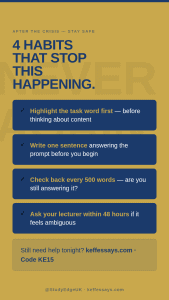
Once you have navigated this deadline, these habits will make sure it never happens again:
- Highlight the task word immediately. Every time you receive an essay prompt, find and highlight the task word before you think about content or structure.
- Write a one-sentence answer to the prompt before you write anything else. This forces you to prove to yourself that you understand the question clearly enough to begin.
- Check back against the prompt every 500 words. Periodically re-read the original prompt and ask: is what I just wrote answering this question?
- Ask your lecturer for clarification early. If a prompt feels ambiguous, ask within the first 48 hours of receiving it — not the night before it is due.
For a comprehensive breakdown of every task word used in UK university essay prompts — and exactly what each one requires from your answer — Scribbr’s Guide to Understanding Essay Questions has the most practical free guide available. We also put together a complete guide specifically for UK university students on how to identify task words and structure your answer correctly. You can read it here: How to Read Your Essay Prompt Correctly — @keffessays on X.
FAQ
What happens if I submit an essay that misinterprets the prompt?
The consequences depend on how far off your interpretation is. A slight misinterpretation typically results in a lower mark within the passing range. A complete misinterpretation — where the essay answers a different question entirely — can result in a fail mark. Most UK universities allow one resubmission opportunity for failing essays, often capped at the minimum passing grade. Check your university’s academic regulations for the specific policy that applies to you.
Should I tell my lecturer I misinterpreted the prompt?
Yes — but frame it as seeking clarification rather than confessing an error. The email template in Step 4 of this guide is the right approach. Most lecturers are more helpful than students expect when approached honestly and before the deadline rather than after submission.
Can I still pass if I realise I have misinterpreted the prompt the night before submission?
Yes — if you follow the 7-step rescue process in this guide. The key variables are how far off your interpretation is and how much time you have. Students in Situation A and B can almost always recover to a passing grade with focused effort. Students in Situation C with very limited time remaining may need professional academic support to produce a submission that meets the standard required.
How do I identify the task word in a complex essay prompt?
Look for the action verb — the word that tells you what to do rather than what to write about. In the prompt “Critically evaluate the impact of social media on political discourse in the UK since 2010,” the task word is “critically evaluate.” Everything else — the topic, the context, the time constraint — is secondary to performing that task correctly throughout every paragraph.
Have you ever misinterpreted an essay prompt and had to rescue it before a deadline? Share what worked for you in the comments below — your experience might help someone else going through exactly this right now 👇