
The reviewing process is one of the most commonly assigned and least understood tasks in UK and US university education. Whether you have been asked to write a book review, an article review, a critical review, or a literature review, the underlying skills are the same — and most students never receive a clear explanation of what those skills actually are.
This complete guide to writing reviews covers everything UK and US university students need to know: what academic review work actually requires, the different types of reviews you will encounter at university, the structure that works for every this type of review task, the most common mistakes that cost students marks, and exactly how to write a review that earns a strong grade.
By the end of this guide you will understand evaluative writing at a level that most students never reach — and you will have a framework you can apply to every critical analysis writing task you face for the rest of your degree.
What Is Review Writing at University Level?
This academic skill at university level is the practice of critically evaluating a piece of work — a book, a journal article, a film, a policy, a research study, or any other source — and presenting that evaluation in a structured academic argument.
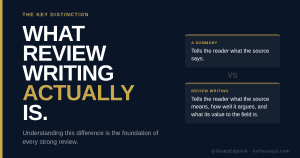
This is fundamentally different from summarising. A summary tells the reader what something says. This form of writing tells the reader what something means, how well it argues its case, what its strengths and limitations are, and how it fits into the broader academic conversation on that topic.
The University of Oxford’s Academic Writing guidance makes this distinction clearly — university-level writing is less concerned with what you know and more concerned with how you construct a critical argument. Critical reviewing is the purest expression of that principle.
Understanding what academic reviewing actually demands — critical evaluation, not description — is the foundation of every strong review at university level.
The 4 Types of Review Writing UK and US Students Encounter
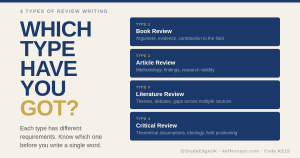
Before you begin any this assignment task, you need to know exactly which type of review you are being asked to produce. Each type has different requirements, a different scope, and a different purpose.
1. Book Review Writing
A book review evaluates a single published work — its argument, its evidence, its structure, its contribution to the field, and its limitations. Book this type of academic writing at university level is not a plot summary or a description of chapters. It is a critical assessment of whether the book succeeds in what it sets out to do and why that matters to the academic discipline.
A strong book review covers: the author’s central argument, the evidence used to support it, the theoretical framework applied, the strengths of the work, the limitations or gaps, and the contribution the book makes to the existing literature on the topic.
2. Article Review Writing
Article analytical writing evaluates a single journal article or academic paper. This type of this task requires you to assess the research methodology, the quality of evidence, the validity of the conclusions, and the significance of the findings within the broader field. Article this type of assignment is particularly common in science, social science, and healthcare disciplines.
3. Literature Review Writing
A literature review is the most substantial form of this writing task at university level and the one most commonly required in dissertations and research projects. Rather than evaluating a single source, literature analytical writing synthesises multiple sources — identifying themes, patterns, agreements, contradictions, and gaps across the existing body of research on a topic.
Literature this writing task is not a list of summaries. It is a thematic argument that maps the existing knowledge landscape and positions your own research within it.
4. Critical Review Writing
A critical review is the most analytically demanding form of the reviewing process. It requires you to evaluate a source not just on its own terms but in relation to other work in the field — assessing its theoretical assumptions, its methodological choices, its ideological positioning, and its contribution to ongoing academic debates.
| Type | Scope | Primary Focus | Common In |
|---|---|---|---|
| Book Review | Single book | Argument and contribution | Humanities, Social Sciences |
| Article Review | Single journal article | Methodology and findings | Sciences, Healthcare, Psychology |
| Literature Review | Multiple sources | Themes and gaps in the field | Dissertations, research projects |
| Critical Review | Single or multiple sources | Theoretical and ideological analysis | Postgraduate, advanced undergraduate |
The Structure of Effective Academic review work
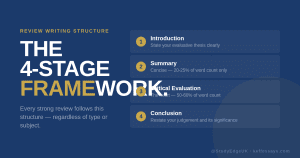
Regardless of which type of evaluative writing you are producing, the underlying structure follows the same logic. Every strong piece of academic writing moves through four stages.
Stage 1 — Introduction
Your introduction establishes the context for your writing reviews. It should identify the source being reviewed, provide brief background on its significance, and state your overall evaluative position — your thesis. What is your central judgement about this work? State it clearly in your introduction so your reader knows the direction of your argument from the beginning.
The most common critical analysis writing mistake at this stage is writing a purely descriptive introduction — summarising what the source is about without indicating your evaluative stance. Your introduction must signal that this is a critical review, not a description.
Stage 2 — Summary of the Source
Before you can evaluate something critically, your reader needs to understand what it says. Your review should include a concise, accurate summary of the source’s main argument, methodology, and key findings or claims. Keep this section proportionally short — typically 20-25% of your total word count. The evaluation is the substance of this type of review, not the summary.
Stage 3 — Critical Evaluation
This is the heart of your review and where the majority of your word count should sit — typically 50-60%. Your evaluation should assess the source across several dimensions:
- Argument quality — Is the central claim clearly stated and logically argued?
- Evidence — Is the evidence credible, sufficient, and properly used?
- Methodology — For research-based sources, is the methodology appropriate and rigorous?
- Theoretical framework — What theoretical assumptions underpin the work and are they justified?
- Strengths — What does the source do particularly well?
- Limitations — What are the gaps, weaknesses, or blind spots?
- Contribution — How does this source advance understanding of the topic?
Strong your review does not just identify strengths and weaknesses in isolation. It explains why they matter — how they affect the reliability of the argument and the value of the work to the field.
Stage 4 — Conclusion
Your conclusion brings your review to a clear close. Summarise your overall evaluation, restate your central judgement, and indicate the significance of the source for the field. Your conclusion should answer one question: given everything you have analysed, what is the value of this work and why does it matter?
How to Write a Literature Review — The Most Demanding Type
Literature critical reviewing deserves its own section because it is structurally different from other types of academic reviewing and is the form most likely to appear in your dissertation or major research project.
The fundamental principle of a literature review is synthesis, not summary. You are not writing a series of mini-reviews of individual sources. You are building an argument about the state of knowledge on your topic — identifying what researchers agree on, where they disagree, what has been studied extensively, and what has been neglected.
The UK Quality Assurance Agency (QAA) benchmarks state that postgraduate students should demonstrate the ability to critically evaluate existing research and identify gaps in knowledge. Literature this task is the primary vehicle for demonstrating this capability.
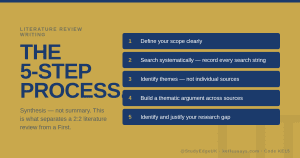
The 5-Step Literature Review Writing Process
- Define your scope. What are the boundaries of your literature review? What time period, geographical context, and sub-topics will you include? Stating your scope clearly in your introduction prevents your review from becoming unmanageably broad.
- Search systematically. Use academic databases — PubMed for health sciences, PsycINFO for psychology, JSTOR for humanities, Google Scholar for cross-disciplinary searches. Record every search string you use so your methodology is transparent.
- Identify themes not sources. As you read, resist the temptation to organise your notes by author or date. Instead, identify the themes, debates, and questions that run across multiple sources. These themes will become the sections of your literature this assignment.
- Build a thematic argument. Each section of your literature this type of academic writing should address one theme and synthesise what multiple researchers have said about it — where they agree, where they diverge, and what remains unresolved.
- Identify and justify your gap. The conclusion of your literature analytical writing should identify the specific gap in existing knowledge that your own research addresses. This gap is the justification for your entire dissertation.
For comprehensive guidance on academic referencing within literature this writing task, Scribbr provides free guides on Harvard, APA, and all major referencing styles used by UK and US universities.
The 7 Most Common Review Writing Mistakes at University
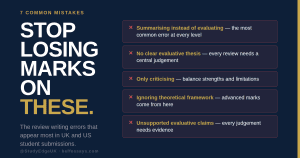
These are the seven academic review work errors that appear most consistently in student submissions at UK and US universities — and the ones that cost the most marks.
- Mistake 1 — Summarising instead of evaluating. The most common this type of review error at every level. Description is not evaluation. Every paragraph of your review must contain a critical judgement, not just a report of what the source says.
- Mistake 2 — No clear thesis. Evaluative writing without a central evaluative argument reads as a list of observations. State your overall judgement clearly in your introduction and let every section of your critical analysis writing support it.
- Mistake 3 — Only identifying weaknesses. Strong your review is balanced. Acknowledging the genuine strengths of a source alongside its limitations demonstrates analytical maturity and earns more marks than pure criticism.
- Mistake 4 — Ignoring the theoretical framework. Every academic work operates within a theoretical tradition. Advanced the review identifies and evaluates those theoretical assumptions — not just the surface argument.
- Mistake 5 — Losing sight of the review focus. In literature this academic skill especially, students often drift into summarising individual sources rather than maintaining the thematic argument. Every paragraph of your literature this form of writing should serve the overall argument about the state of knowledge on your topic.
- Mistake 6 — Poor referencing. Critical reviewing requires you to cite both the source being reviewed and any secondary sources you use to support your evaluation. Inconsistent or incorrect referencing undermines even strong analytical academic reviewing.
- Mistake 7 — Unsupported claims. every evaluative claim in your review claim must be supported. If you say a methodology is flawed, explain why, citing evidence. Assertions without support are the mark of a weak review.
For further guidance on avoiding common academic writing errors, Purdue OWL is the most comprehensive free academic writing resource available to UK and US university students.
Review Writing Language — How to Sound Critical Without Being Harsh
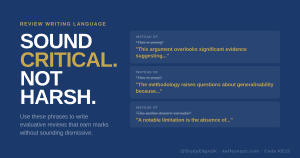
One of the challenges students face in analytical writing is finding language that is appropriately critical without being dismissive or unacademic. This writing task requires evaluative language — words and phrases that convey judgement while maintaining the tone of scholarly analysis.
Use these phrases to strengthen your academic reviews:
| Instead of | Use in The reviewing process |
|---|---|
| “This book is wrong” | “This argument overlooks the significant body of evidence suggesting…” |
| “This is a good point” | “This finding makes a valuable contribution to the field by…” |
| “I think this is weak” | “The methodology raises questions about the generalisability of these findings because…” |
| “The author doesn’t consider” | “A notable limitation of this analysis is the absence of…” |
| “This is interesting” | “This perspective offers a productive framework for understanding…” |
| “I agree with this” | “This conclusion is consistent with the broader consensus in the literature that…” |
Strong the language of critical evaluation is precise, measured, and evidenced. It avoids both uncritical praise and unsupported dismissal.
Review Writing for Different Disciplines — What Changes
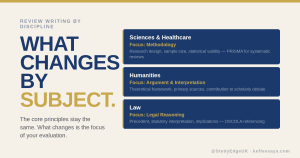
While the core principles of academic review work apply across all disciplines, different academic fields have specific conventions and expectations that your evaluative writing must reflect.
Review Writing in the Sciences and Healthcare
Scientific your review places heavy emphasis on methodology. When reviewing a research study, your evaluation must assess the research design, sample size, controls, statistical analysis, and the validity of the conclusions drawn from the data. Systematic reviews and meta-analyses follow specific protocols — the PRISMA framework is the standard for healthcare this academic skill in the UK and US.
Review Writing in the Humanities
Humanities this form of writing focuses more heavily on argument and interpretation. When reviewing a historical text, a literary work, or a philosophical argument, your evaluation assesses the quality of the interpretive framework, the use of primary and secondary sources, the originality of the argument, and its contribution to ongoing scholarly debates in the field.
Review Writing in Law
Legal critical reviewing evaluates cases, judgements, statutes, or academic commentary. It requires precise analysis of legal reasoning, the application of precedent, and the implications of the legal argument for future cases or policy. OSCOLA referencing is standard for law academic reviewing in the UK.
Review Writing in Social Sciences
Social science this task must evaluate both the theoretical framework and the empirical evidence. It requires attention to the researcher’s positionality, potential biases in data collection, and the cultural or contextual limitations of the findings.
Step-by-Step Review Writing Checklist
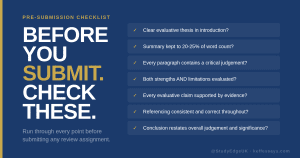
Before submitting any review before submission, work through this checklist to confirm every requirement has been met.
- ☐ Does my introduction state a clear evaluative thesis about the source?
- ☐ Have I provided a concise summary of the source without making it the focus of the review?
- ☐ Does every paragraph contain a critical judgement — not just description?
- ☐ Have I evaluated both the strengths and limitations of the source?
- ☐ Have I identified the theoretical framework underpinning the source?
- ☐ Is every evaluative claim supported by evidence or reasoning?
- ☐ Does my conclusion restate my overall judgement and explain the significance of the source?
- ☐ Is my referencing consistent and correct throughout?
- ☐ Is my language appropriately academic and evaluative throughout?
- ☐ Have I checked my word count and confirmed I am within the required range?
If you are struggling with your mental health alongside your academic workload, Student Minds is the UK’s leading student mental health charity — free support, genuinely helpful.
FAQ
What is this assignment in university?
This type of academic writing at university level is the critical evaluation of a source — a book, journal article, research study, or body of literature. Unlike a summary, the review requires you to assess the quality, significance, strengths, and limitations of the work and present that evaluation as a structured academic argument. The key skill in this academic skill is critical analysis, not description.
What is the difference between a summary and this form of writing?
A summary reports what a source says. Critical reviewing evaluates what a source means, how well it argues its case, and what its contribution to the field is. At university level, a review that only summarises without evaluating will typically receive a failing or low grade regardless of how accurately the source has been described. The critical evaluation is the substance of this academic genre.
How long should a university review be?
The length of academic reviewing varies by assignment type and level. A book or article review for an undergraduate module is typically 500 to 1,500 words. A critical review at postgraduate level may be 2,000 to 3,000 words. A literature review within a dissertation is typically 2,500 to 5,000 words depending on the total word count of the dissertation. Always check your specific assignment brief and university guidelines for the exact word count required.
How do I start this task?
Begin your this assignment by reading the source carefully and taking notes on its central argument, evidence, methodology, and theoretical framework. Then identify your overall evaluative position — what is your central judgement about this work? Start your actual writing with the introduction, stating this position clearly. If you find it difficult to form an evaluative position before writing, begin with the summary section and let your critical judgement develop as you analyse the source more deeply.
What type of this type of academic writing do you find most challenging at university? Share it in the comments below — we read every one and will help you work through it 👇