
Knowing how to write UCAS personal statement is one of the most important skills any sixth-form or college student in the UK can develop — and in 2026, the rules have changed in a way that most students and parents don’t fully understand yet. UCAS has replaced the old free-text format with three structured questions, and if you approach the new format using the old method, you will underperform regardless of how strong your application is. This guide covers everything: what the new format requires, how to answer each of the three questions, the mistakes that cost students offers every year, and how professional writing support can sharpen every word of your statement before submission.
What Is a UCAS Personal Statement and Why Does It Matter?
Your UCAS personal statement is a written section of your university application through which you explain to admissions staff why you want to study your chosen course, what academic experience qualifies you, and what you have done outside the classroom to prepare. It is submitted through the UCAS Hub alongside your qualification data and your teacher’s reference — and it is the one part of the application that is entirely yours to control.
Universities use the personal statement to do two things: first, to assess whether you are genuinely engaged with the subject you want to study; and second, to differentiate between applicants who share similar predicted grades. When two candidates both hold the same offer — say, AAB — the personal statement is often the deciding factor. For competitive courses such as Medicine, Law, Psychology, and Economics at Russell Group universities, the personal statement can determine whether you receive an offer, an interview invitation, or a rejection.
According to UCAS official guidance on the 2026 personal statement format, the personal statement is reviewed as a single piece of writing by admissions teams, even though it is now split across three separate questions. This means the quality of your thinking and the consistency of your narrative matters as much as the factual content you include.
What Has Changed: The New UCAS Personal Statement Format for 2026
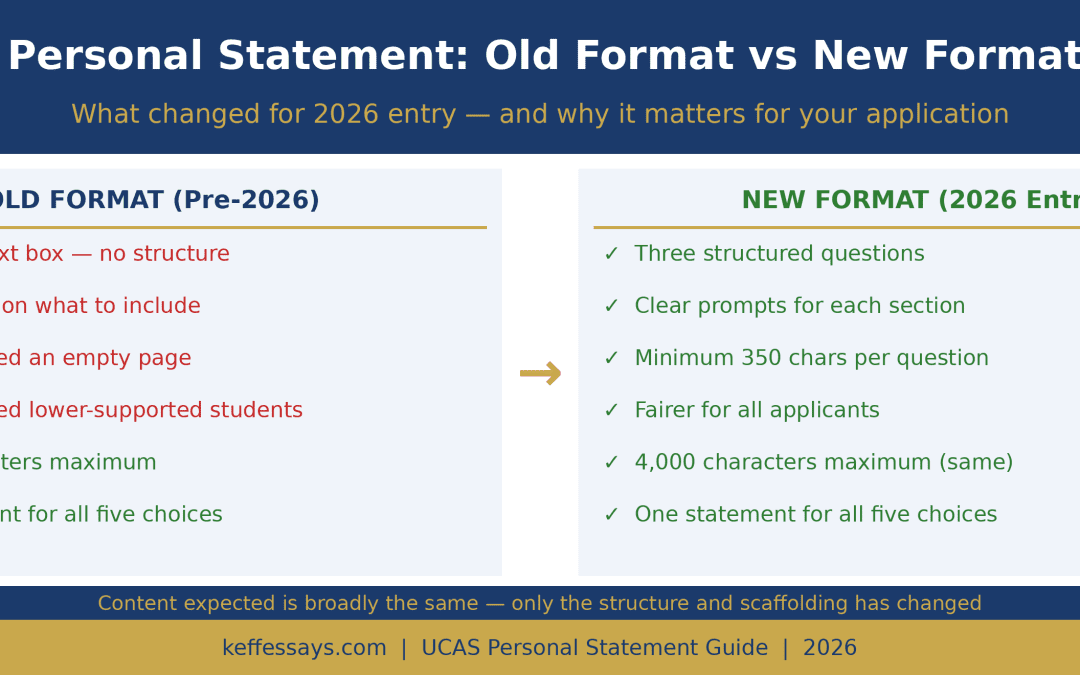
The most important thing to understand when learning how to write UCAS personal statement for 2026 entry is that the format has fundamentally changed. From September 2025, UCAS replaced the old single free-text field with three structured questions. Every applicant — whether applying for Medicine at Imperial or Film Studies at Falmouth — now answers exactly the same three prompts.
The old format required students to write one continuous piece of text of up to 4,000 characters. Many students struggled with this because they faced a blank page with no guidance on what to include or how to structure their response. Research by UCAS found that students with access to strong school or parental support consistently outperformed those without — which created an unfair advantage based on background rather than ability. The three-question scaffolding system was introduced specifically to address this imbalance and give all applicants the same structural clarity.
What stays the same:
- Maximum 4,000 characters in total (including spaces)
- Reviewed as one complete statement by universities
- Must be original — UCAS runs a plagiarism detection system
- One statement submitted to all five university choices
What has changed:
- Three separate question boxes instead of one open field
- Each question has a minimum of 350 characters
- The structure of what you need to address is now explicit
- No blank page — every applicant knows exactly what each section requires
The Three UCAS Personal Statement Questions for 2026 (Exact Wording)
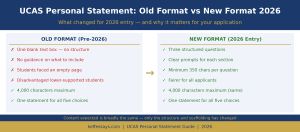
Understanding how to write UCAS personal statement in the new format starts with knowing precisely what the three questions are and what each one is designed to assess.
Question 1: Why do you want to study this course or subject?
This question assesses your genuine motivation and intellectual engagement with your chosen subject. Admissions staff want to understand what sparked your interest, how you have explored it beyond the classroom, and why this particular course is the right fit for your academic and career goals. A strong answer to Question 1 goes beyond saying you enjoy the subject — it demonstrates that you have engaged with it critically, pursued it independently, and can articulate a clear rationale for why you want to spend three or more years studying it at degree level.
Question 2: How have your qualifications and studies helped you to prepare for this course or subject?
Question 2 is where you demonstrate academic readiness. This is your opportunity to connect your current or recent qualifications directly to your chosen degree — identifying specific subjects, modules, coursework, essays, or research that have given you the skills and knowledge base required. UCAS guidance is clear: do not repeat qualification data already listed elsewhere in your form. Instead, identify transferable skills and specific academic experiences that prove you are prepared for degree-level study in this discipline.
Question 3: What else have you done to prepare outside of education, and why are these experiences useful?
Question 3 covers everything outside formal academic study — work experience, volunteering, extracurricular activities, personal responsibilities, hobbies, and any life experiences that have shaped your readiness for university. Critically, UCAS guidance emphasises that you must explain why each experience is relevant to your chosen course. Listing activities without connecting them to your application adds no value and wastes character count.
How to Write a UCAS Personal Statement: Question 1 Step by Step
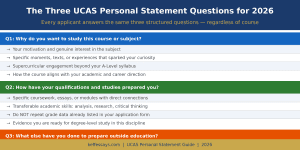
The strongest answers to Question 1 when learning how to write UCAS personal statement follow a three-part structure: the origin of your interest, how you have developed it, and how it connects to your future.
Part 1 — The Origin (avoid clichés) Admissions tutors read thousands of statements and they consistently flag one opening above all others as ineffective: “I have always been passionate about…” This phrase tells the reader nothing. Instead, identify a specific moment, text, person, or experience that genuinely crystallised your interest in the subject. The more specific the example, the more credible your motivation appears.
Examples that work:
- A particular book or academic paper that reframed your understanding
- A news event or documentary that raised questions your current studies couldn’t answer
- A work experience placement that gave you real-world context for the subject
- A teacher, mentor, or family member whose work influenced your direction
Part 2 — How You Developed the Interest Universities want evidence of supercurricular engagement — the things you did beyond your A-Level or BTEC coursework to deepen your understanding. This could include:
- Extended reading outside your syllabus
- Attending open days, subject lectures, or summer schools
- Online courses from platforms like Coursera, edX, or FutureLearn
- Subject competitions, societies, or student publications
- Podcasts, journals, or documentaries you have engaged with critically
Be specific. Name the book. Name the author. Describe what you learned and how it changed your thinking. One well-developed example with genuine critical reflection is worth more than a list of six surface-level mentions.
Part 3 — Connection to the Course and Future Close Question 1 by connecting your interest to your chosen degree and, where relevant, to your career goals or further academic ambitions. You do not need a fully formed five-year plan — but demonstrating that you have researched what the course involves and why it aligns with where you want to go shows admissions staff that your application is considered rather than speculative.
If you want your Question 1 answer to be reviewed, edited, and strengthened by a specialist UK academic writer, our personal statement editing service at keffessays.com is available for same-day turnaround.
How to Write a UCAS Personal Statement: Question 2 Step by Step
Question 2 is where many applicants underperform — not because they lack academic achievement, but because they default to listing qualifications rather than analysing what those qualifications demonstrate.
What admissions teams are looking for in Question 2:
- Evidence that your current studies have built the analytical, writing, or technical skills the course requires
- Specific examples of coursework, essays, projects, or modules that connect directly to your degree
- Transferable skills — critical thinking, research methodology, data analysis, argumentation — evidenced through your academic experience
- A clear line of logic between what you have studied and why you are ready for what comes next
What to avoid in Question 2:
- Repeating grades or predicted results already listed in your qualification section
- Generic statements such as “studying English has improved my communication skills”
- Listing every subject you study without explaining the relevance of each
- Writing about qualifications that have no connection to your chosen course
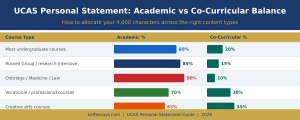
The 80:20 ratio rule: According to <a href=”https://www.timeshighereducation.com/counsellor/admissions-processes-and-funding/guide-2026-changes-ucas-personal-statement” target=”_blank” rel=”noopener noreferrer”>Times Higher Education’s guide to the 2026 UCAS changes</a>, the personal statement — across all three questions — should be approximately 80% academic and 20% co-curricular for competitive courses. For applications to elite or research-intensive universities, this ratio moves closer to 90:10.
Need help ensuring your Question 2 demonstrates the right level of academic depth for your chosen course? Our university application writing team at keffessays.com works with students applying to all UK institutions including Russell Group, Oxbridge, and specialist colleges.
How to Write a UCAS Personal Statement: Question 3 Step by Step
Question 3 gives applicants the most creative freedom — but it is also the section most likely to be wasted on irrelevant content. The single rule that governs every word you write in Question 3 is this: everything must connect to your chosen course. If you cannot explain why an activity, experience, or responsibility is relevant to what you want to study, it does not belong in your statement.
High-value content for Question 3:
- Work experience directly related to your course (clinical shadowing for Medicine, legal work experience for Law, financial industry exposure for Economics)
- Volunteering that demonstrates skills the course requires — empathy for nursing, leadership for business, communication for education
- Personal responsibilities such as caring for a family member — connect these to qualities like resilience, time management, and maturity
- Independent projects, self-directed research, or creative portfolios
- Part-time employment that has built relevant professional skills
- Hobbies that demonstrate subject engagement — a student applying for Computer Science who builds apps in their free time, or one applying for History who leads a debating society
Content to avoid in Question 3:
- Generic team sports without explanation of relevance
- School positions (prefect, house captain) without connecting the skills to your subject
- Achievements that are listed rather than reflected on
- Anything that could appear in someone else’s statement applying to a completely different course
![Question 3 Content Guide: Include vs Avoid]](https://keffessays.com/wp-content/uploads/2026/03/ucas-personal-statement-question-3-content-guide-300x144.png)
UCAS Personal Statement Character Count: How to Allocate 4,000 Characters
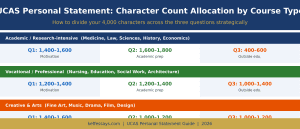
One of the most practical questions students ask when learning how to write UCAS personal statement is how to divide 4,000 characters across the three questions. UCAS does not mandate a specific split — the minimum per question is 350 characters, and you can allocate the remaining characters however you choose.
The most effective allocation for most applicants depends on their course and experience:
For academic, research-intensive courses (Medicine, Law, Sciences, History, Philosophy, Economics):
- Question 1: 1,400–1,600 characters (motivation and intellectual engagement)
- Question 2: 1,600–1,800 characters (academic preparation — most important section)
- Question 3: 400–600 characters (relevant extracurricular, kept brief)
For vocational and professional courses (Nursing, Education, Social Work, Architecture, Sports Science):
- Question 1: 1,200–1,400 characters (motivation and course fit)
- Question 2: 1,200–1,400 characters (relevant qualifications and transferable skills)
- Question 3: 1,000–1,400 characters (work experience and practical preparation are weighted heavily)
For creative and arts courses (Fine Art, Music, Drama, Film, Design):
- Question 1: 1,400–1,600 characters (passion, creative journey, and artistic development)
- Question 2: 1,000–1,200 characters (relevant technical education)
- Question 3: 1,000–1,200 characters (portfolio work, exhibitions, independent creative projects)
Always write your draft in a word processor first and track your character count there — but note that character counts in Word or Google Docs may differ slightly from the UCAS system. Always do your final count check directly in the UCAS Hub before submission.
If you need help structuring your personal statement to use the 4,000 characters as effectively as possible for your specific course, the writing specialists at keffessays.com can produce a tailored draft or review and edit your existing version.
The 8 Most Common UCAS Personal Statement Mistakes to Avoid in 2026
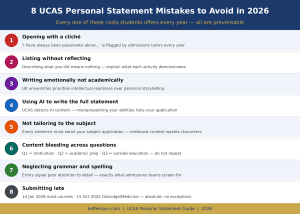
Students who understand how to write UCAS personal statement effectively know that what you leave out matters as much as what you include. These eight mistakes appear in applications every year and cost students offers at universities they were otherwise qualified to attend.
Mistake 1 — Opening with a cliché “I have always been passionate about…” “From a young age, I knew I wanted to…” “As far back as I can remember…” These phrases are listed in UCAS guidance and by admissions tutors as the most overused openings in the system. They say nothing, waste characters, and immediately signal to the reader that the statement was written without originality. Start with a specific, concrete example instead.
Mistake 2 — Listing achievements without reflection Describing what you have done is not the same as demonstrating why it matters. An admissions tutor reading that you achieved a Grade 8 in piano, captained the hockey team, and volunteered at a food bank learns nothing about your readiness for your chosen course unless you connect each activity to a specific skill or insight relevant to your degree.
Mistake 3 — Writing emotionally rather than academically UK universities — particularly research-intensive institutions — prioritise subject engagement and intellectual readiness. Storytelling is appropriate in a personal statement only when it leads directly to academic or intellectual insight. If your statement reads more like a personal essay than an academic case for your application, restructure it.
Mistake 4 — Using AI to write the full statement UCAS has explicitly stated that generating and submitting a personal statement written by AI tools such as ChatGPT constitutes a form of cheating that could affect your chances of an offer. UCAS runs plagiarism and similarity detection software, and universities can identify AI-generated writing. AI can be used for brainstorming or editing — but the statement must be written in your own voice.
Mistake 5 — Not tailoring to the subject Your personal statement is sent to all five of your university choices simultaneously — you write one statement, not five. This means it must be relevant to your subject across all five applications. If you are applying to five different courses, your statement will be severely weakened. Apply to the same or closely related subjects, and ensure every sentence in your statement serves your subject application.
Mistake 6 — Ignoring Question boundaries With the new three-question format, some applicants make the mistake of letting content bleed across questions — writing about motivation in Question 2, or repeating extracurricular activities already covered in Question 3. UCAS guidance is clear: do not repeat information. Use each question for its intended purpose and make every character work distinctly.
Mistake 7 — Neglecting grammar and spelling Admissions staff read personal statements as evidence of academic writing ability. Spelling errors and grammatical mistakes signal a lack of care and attention — qualities no admissions team wants to see in a prospective student. Have at least two people proofread your statement before submission: your teacher, and ideally a subject-specialist or professional writer.
Mistake 8 — Submitting late The equal consideration deadline for most undergraduate courses is 14 January 2026. According to the <a href=”https://www.ucas.com/applying/applying-to-university/dates-and-deadlines-for-uni-applications” target=”_blank” rel=”noopener”>UCAS key dates and deadlines page</a>, applications submitted after this date are marked as late and may only be considered if places remain. For Oxford, Cambridge, Medicine, Dentistry, and Veterinary Science, the deadline is 15 October 2025 at 18:00 UK time — non-negotiable, no exceptions.
UCAS Personal Statement Deadlines 2026: What You Cannot Miss
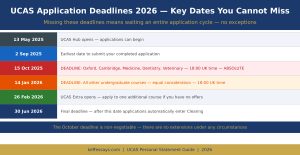
When planning how to write UCAS personal statement, the deadlines are not flexible. Miss the wrong one and it is not a matter of a late penalty — it can mean waiting an entire application cycle. You can find all confirmed dates on the <a href=”https://www.ucas.com/applying/applying-to-university/dates-and-deadlines-for-uni-applications” target=”_blank” rel=”noopener noreferrer”>UCAS key dates and deadlines page</a>.
15 October 2025 at 18:00 UK time Deadline for applications to Oxford, Cambridge, and most Medicine, Dentistry, and Veterinary Medicine courses. This deadline is absolute. There are no extensions. Late applications are not considered for these courses — and universities will not make exceptions regardless of circumstances. If you are applying for any of these, your personal statement must be complete and submitted by this date.
14 January 2026 at 18:00 UK time Equal consideration deadline for all other undergraduate courses. Applications submitted by this date are guaranteed to be considered equally by universities. Applications submitted after this date are flagged as late and universities are not obliged to consider them — particularly for popular or oversubscribed courses.
26 February 2026 UCAS Extra opens. If you applied by the January deadline and received no offers, or if you declined all your offers, Extra allows you to apply to one additional course at a time.
30 June 2026 Final application deadline. Applications received after this date automatically enter Clearing — where available places are far more limited and course choice is severely restricted.
For students applying to Oxford or Cambridge specifically: you cannot apply to both in the same cycle. You submit one application to one institution only. <a href=”https://www.ox.ac.uk/admissions/undergraduate/applying-to-oxford/guide/ucas-application” target=”_blank” rel=”noopener”>The University of Oxford UCAS application guide</a> confirms this and provides full instructions for Oxbridge applicants.
What Admissions Tutors Actually Look for in a Personal Statement
Every admissions tutor processes a high volume of applications during the cycle, and the personal statements that stand out consistently demonstrate the same qualities regardless of subject. Understanding what they are looking for is a core part of knowing how to write UCAS personal statement that converts into an offer.
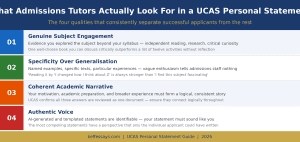
Genuine subject engagement This is the single most important quality. Admissions teams want to see evidence that you have engaged with your subject beyond the syllabus — that you have read around it, questioned it, developed an intellectual curiosity that makes you a student they want in their seminars. A student who has read one well-chosen book beyond their A-Level reading list and can discuss what it made them think will consistently outperform one who lists twelve activities without analysis.
Specificity over generalisation Vague language weakens every personal statement. “I am fascinated by the human body” tells a Medicine admissions tutor nothing. “Reading Atul Gawande’s writing on surgical decision-making made me examine the relationship between clinical skill and patient-centred care” tells them a great deal. Replace every generalisation with a specific example.
Coherent narrative Even with the three-question format, admissions staff review the statement as a whole. Your motivation (Q1), your academic preparation (Q2), and your broader experience (Q3) should form a logical, consistent story about who you are as an academic and why you are ready for this course.
Authentic voice AI-generated or heavily templated statements are identifiable. Your personal statement should sound like you — not a model answer. The most compelling statements have a distinctive perspective that only the individual applicant could have written.
Getting your personal statement right the first time saves weeks of stressful revision. If you want expert support from a writer who understands UK university admissions, keffessays.com provides personal statement editing and drafting services tailored to your specific course and institution.
Can You Use AI to Write Your UCAS Personal Statement?
This is one of the most searched questions among students preparing their applications in 2026, and the answer is nuanced. UCAS guidance makes a clear distinction between using AI as a brainstorming and editing tool and using it to generate the content of your statement.
What UCAS permits:
- Using AI tools to brainstorm ideas, generate outlines, or explore what to include
- Running your draft through AI for grammar and clarity suggestions
- Using AI to identify gaps in your argument or structure
What UCAS prohibits:
- Generating all or a significant portion of your personal statement using AI and submitting it as your own words
- Presenting AI-written content as your original voice and thinking
- Using AI in a way that misrepresents your abilities to admissions teams
The University of Dundee’s admissions guidance notes that UCAS operates plagiarism detection software — and universities can flag statements that share similarities with other submitted statements or that match AI generation patterns. Being caught submitting an AI-written personal statement can result in your application being flagged, your offers being withdrawn, or your application being rejected outright.
The safe principle is straightforward: your ideas, your voice, your experiences — supported by professional editing to ensure clarity, precision, and impact. That is exactly what a legitimate personal statement editing service provides. Our editing team at keffessays.com works with your existing draft to improve it — not to replace your voice with someone else’s.
How to Write a UCAS Personal Statement: Complete Checklist Before You Submit
Before you submit, run through every item on this checklist. Students who understand how to write UCAS personal statement at the highest level treat this checklist as non-negotiable.
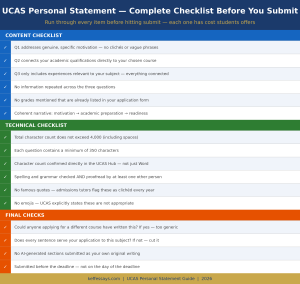
Content checklist:
- Question 1 addresses genuine, specific motivation — no clichés, no vague “passion” statements
- Question 2 connects your academic qualifications directly to your chosen course
- Question 3 includes only experiences that are relevant — every activity is connected to your degree
- No information is repeated across questions
- No grades or qualifications are mentioned that are already listed elsewhere in your form
- The overall narrative is coherent — motivation leads to preparation, preparation leads to readiness
Technical checklist:
- Total character count does not exceed 4,000 (including spaces)
- Each question contains a minimum of 350 characters
- Character count confirmed in the UCAS Hub — not only in Word or Google Docs
- Spelling and grammar checked with a tool AND proofread by at least one other person
- No quotes from famous figures (admissions tutors have confirmed this as a major pet peeve)
- No emojis (UCAS explicitly states these are not appropriate)
- No AI-generated sections submitted as your own original writing
Final checks:
- Ask yourself: could anyone else applying for a different course have written this statement? If yes, it is not specific enough
- Ask yourself: does every sentence serve my application to this subject? If not, cut it
- Submit before the deadline — not on the day of the deadline
When every word needs to work as hard as possible in 4,000 characters, professional editing makes a measurable difference. Book a personal statement review at keffessays.com and receive expert feedback from a UK academic writing specialist within 24 hours.
Important Links
- For guidance on writing at university level once you have your place: How to Write a First Class Essay UK
- For understanding referencing from day one of your degree: APA vs MLA vs Harvard Referencing
- For managing the stress of high-stakes academic deadlines: Dissertation Stress UK Students
- For writing under tight time pressure: How to Write a 2000 Word Essay in One Day
FAQ Section
What is the word limit for a UCAS personal statement in 2026? The UCAS personal statement has a maximum of 4,000 characters in total, including spaces. This applies across all three questions combined. Each individual question must contain a minimum of 350 characters. UCAS does not set a maximum character count per question — you allocate the 4,000 characters across the three sections in whatever way best suits your application and experience.
What are the three UCAS personal statement questions for 2026 entry? The three questions are: Question 1 — Why do you want to study this course or subject? Question 2 — How have your qualifications and studies helped you to prepare for this course or subject? Question 3 — What else have you done to prepare outside of education, and why are these experiences useful? Each question has a minimum of 350 characters and the total across all three must not exceed 4,000 characters including spaces.
When is the UCAS personal statement deadline for 2026? There are two main deadlines. For applications to Oxford, Cambridge, and most Medicine, Dentistry, and Veterinary Medicine courses, the deadline is 15 October 2025 at 18:00 UK time. For all other undergraduate courses, the equal consideration deadline is 14 January 2026 at 18:00 UK time. Applications submitted after the January deadline may not receive equal consideration, and late applications for the October deadline courses are not accepted under any circumstances.
Can you use ChatGPT or AI to write a UCAS personal statement? UCAS guidance permits using AI tools for brainstorming, outlining, and editing — but explicitly states that generating and submitting AI-written content as your own words could be considered cheating by universities and may affect your chances of receiving an offer. UCAS operates similarity detection software. The safest approach is to write your statement in your own voice and use professional human editing support to refine it.
How should you start a UCAS personal statement in 2026? With the new three-question format, Question 1 begins with your motivation for the course. Admissions tutors strongly advise against opening with clichéd phrases such as “I have always been passionate about…”. Instead, open with a specific example — a book, a moment, a person, an experience — that genuinely illustrates when and why your interest in the subject began. Specificity and authenticity are more compelling than generic enthusiasm.
Does a UCAS personal statement need to be different for each university? No. You write one personal statement that is submitted to all five of your university choices simultaneously through UCAS. This is why it is essential that your statement is relevant to your subject broadly, rather than referencing specific universities or courses by name. If you are applying to five different subjects across your choices, your personal statement will be significantly weakened — apply to the same or closely related subjects.
What is the best way to get help with a UCAS personal statement? Start with your school or college teacher for feedback on content and subject relevance. Use UCAS’s own free Personal Statement Toolkit and subject-specific guides available at ucas.com. For students who want their statement professionally reviewed, edited, or drafted by a UK academic writing specialist with knowledge of admissions standards, keffessays.com offers a personal statement editing service with fast turnaround.