
It’s 10pm. Your essay is due tomorrow at 9am. It’s 2,000 words and you haven’t started. Your stomach drops. Your hands go cold. And you type the one thing every panicking student types into Google at this exact moment: how to write a 2000 word essay in one day. You found the right place. This guide walks you through exactly how to write a 2000 word essay in one day — hour by hour, step by step, with zero fluff and zero judgment. Thousands of UK and US students have used this method to get their essays submitted on time. Some have even got decent marks doing it. Take a breath. Let’s go.
Can You Write a 2000 Word Essay in One Day?
Yes, you can write a 2000 word essay in one day. Most students complete it in 5–7 hours by splitting the task into four phases: planning (1 hour), research (1 hour), writing (2–3 hours), and editing (1 hour). The writing itself takes under an hour — what takes time is having a clear plan before you start. Here’s the maths that should calm you down: A university student typing at average speed produces around 40 words per minute. That means pure writing time for 2,000 words is approximately 50 minutes.
You have time. What kills students isn’t the writing — it’s the panicking, the procrastinating, and not having a structure to follow. Every student who has successfully learned how to write a 2000 word essay in one day will tell you the same thing: the plan matters more than the typing. 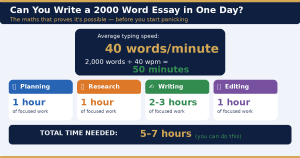
| Phase | Time Required |
|---|---|
| Planning & question analysis | 1 hour |
| Research sprint | 1 hour |
| Writing body paragraphs | 2–3 hours |
| Introduction & conclusion | 45 minutes |
| Editing, referencing & submission | 1 hour |
| Total | 5–7 hours |
If you have 7 or more hours before your deadline, you can absolutely do this. If you have fewer, scroll straight to the 4-hour emergency plan below.
The One Rule to Read Before You Start
Before you write a single word, put this somewhere you can see it:
“A submitted essay always beats a perfect essay that never gets handed in.”
You are not writing a masterpiece today. You are writing a good-enough essay that demonstrates you understand the topic and can construct an argument. That is a completely achievable goal — and it is exactly what this guide will help you do. Phone in another room. Netflix off. Every browser tab closed except one Google Doc. We’re starting.
Hour 1: How Do You Analyse an Essay Question Quickly?
To analyse an essay question quickly, read it three times and identify three things: the command word, the topic, and the scope. This takes 15 minutes and is the most important investment you will make. Misreading the question is the single biggest reason students fail under deadline pressure — you write 2,000 brilliant words on the wrong thing and fail regardless. 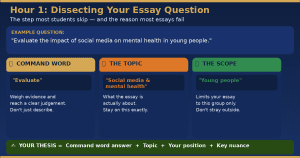
What Do Essay Command Words Mean?
Essay command words tell you exactly what kind of response your lecturer expects. Confusing them is one of the fastest ways to lose marks even on a well-written essay.
| Command Word | What It Means |
|---|---|
| Analyse | Break the topic into parts and examine each one |
| Evaluate | Weigh up the evidence and reach a clear judgement |
| Discuss | Explore different perspectives and arguments |
| Compare/Contrast | Identify similarities and differences |
| Critically assess | Examine evidence and make a reasoned judgement |
| Explain | Give reasons and make something clearly understood |
How Do You Write a Thesis Statement Quickly?
To write a thesis statement quickly, answer the essay question in one sentence using the most direct, specific response you can. This sentence becomes your compass for the entire essay — every paragraph you write must connect back to it. Example:
Question: “Evaluate the impact of social media on mental health in young people.” Thesis: “Social media has a broadly negative impact on mental health in young people, though its effects vary significantly by platform, usage type, and individual vulnerability.”
Write that sentence down. Keep it visible. Everything else in your essay serves that one idea.
How Do You Plan a 2000 Word Essay Structure?
A 2000 word essay should be structured as a 200-word introduction, five body paragraphs of approximately 300 words each, and a 200-word conclusion. Write one bullet point per body paragraph — one sentence stating the main argument. That list is your entire plan. It takes five minutes and makes the actual writing significantly faster. Example plan:
- Studies show a correlation between heavy social media use and depression in adolescents
- The “compare and despair” mechanism — curated content drives low self-esteem
- Algorithmic amplification of harmful content increases exposure risk
- Counter-argument: some studies show positive community effects
- Platform design and screen time limits as key variables in outcome
Done. That’s your essay. Now go find the evidence.
Hour 2: How Do You Research an Essay Quickly?
To research an essay quickly, use Google Scholar to find 5–6 credible academic sources and extract only three things from each: one key statistic or finding, the author name and year, and one direct quote with a page number. Stop researching after 60 minutes — this is the most important time limit in this entire guide. Research rabbit holes are the number one reason one-day essays fail. 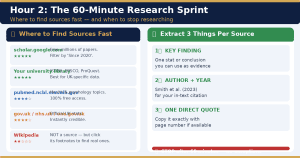
Where Is the Best Place to Find Academic Sources Fast?
The best place to find academic sources quickly is Google Scholar (scholar.google.com), which gives free access to millions of peer-reviewed papers. Type your main topic and key concepts, then filter results by “Since 2020” to get recent sources. For UK-specific topics, supplement with NHS, GOV.UK, and ONS websites — these are automatically credible and freely accessible without a login. Other fast-access databases worth knowing:
- Your university library portal — JSTOR, EBSCO, ProQuest with your student login
- PubMed — free access for health, medicine, and psychology topics
- Google Scholar “Cited by” feature — find one good paper, click “Cited by” to instantly find newer papers on the same topic
How Many Sources Does a 2000 Word Essay Need?
A 2000 word essay typically requires 6–8 sources at UK university level. Under time pressure, aim for a minimum of 5 solid academic sources, supplemented by 2–3 supporting references from credible websites or reports. Quality beats quantity every time — five well-used sources are far stronger than ten poorly cited ones.
Is Wikipedia Acceptable as an Essay Source?
Wikipedia is not an acceptable academic source for a university essay, but it is a legitimate starting point for finding real sources. Click through to the footnotes at the bottom of any Wikipedia article and use those referenced papers and books as your actual sources. Under deadline pressure, this is one of the fastest legitimate research shortcuts available.
Hours 3 & 4: How Do You Write Essay Body Paragraphs Quickly?
To write essay body paragraphs quickly, use the PEEL structure: Point, Evidence, Explain, Link. Every paragraph starts with your argument, introduces your source, analyses what the evidence means, then connects back to your thesis. Following this formula removes the need to think about structure while you write — you only need to think about content. This is the core method behind every guide on how to write a 2000 word essay in one day that actually works. 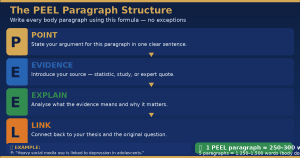
What Is the PEEL Paragraph Structure?
The PEEL paragraph structure is a four-part formula: Point (state your argument), Evidence (introduce your source), Explain (analyse what the evidence means), and Link (connect back to the thesis). Each PEEL paragraph produces approximately 250–300 words, which means five PEEL paragraphs gives you the entire body of a 2000 word essay in one focused writing session. Here’s a complete worked example:
Point: There is substantial evidence linking heavy social media use to increased rates of depression and anxiety in adolescents. Evidence: A longitudinal study by Twenge et al. (2018) found that adolescents spending five or more hours per day on social media were 66% more likely to have at least one suicide risk factor compared to those spending only one hour per day.
Explain: This correlation suggests that extended exposure to social media is not merely passively associated with poor mental health outcomes — the dosage matters significantly. The greater the usage, the steeper the risk, implying a relationship that warrants serious policy attention. Link: This evidence supports the argument that social media, particularly when used heavily, poses a measurable and serious risk to adolescent mental health.
That paragraph is 175 words. Write five of them. That’s your entire body section, done.
What Is the Best Way to Write Fast Without Losing Quality?
The best way to write quickly without sacrificing quality is to write continuously without editing as you go. Stopping to edit while you write cuts your output by up to 70% — you interrupt forward momentum every few sentences and end up rewriting paragraphs that were fine. Write ugly first drafts. You will fix them in the editing hour at the end. Use these transitional phrases to connect paragraphs without breaking your flow:
- “Furthermore, …”
- “In contrast to this view, …”
- “This point is reinforced by …”
- “However, it is important to consider …”
- “Building on this argument, …”
If you get stuck on a paragraph, write [FINISH LATER] and move to the next one. Keep moving forward.
Hour 5: Should You Write the Introduction First or Last?
You should always write your essay introduction last, after the body paragraphs are complete. Writing the introduction first forces you to introduce an argument you haven’t fully developed yet. Students who write introductions first consistently produce weaker openings because they’re guessing at what their essay will argue. Write the body, then introduce it. 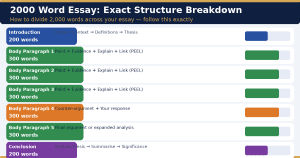
How Do You Write a Strong Essay Introduction in 20 Minutes?
To write a strong 200-word introduction quickly, follow a four-part formula: an engaging hook (1–2 sentences), brief background context (2–3 sentences), definitions of key terms (1–2 sentences), and a clear thesis statement (1–2 sentences). Never open with “Throughout history…” or “In today’s modern world…” — lecturers have read these millions of times and they signal weak academic writing immediately. Example introduction:
In an era where the average teenager spends over seven hours per day looking at screens, the relationship between social media and mental health has become one of the most urgently debated topics in public health. With rates of adolescent anxiety and depression rising sharply across the UK and US since 2012 — precisely when smartphone adoption accelerated — researchers and policymakers are questioning whether the two are connected.
For the purposes of this essay, “social media” refers to platforms that prioritise user-generated content and peer interaction, including Instagram, TikTok, and X. This essay argues that social media has a broadly negative impact on mental health in young people, though its effects are mediated by usage patterns, platform design, and individual psychological vulnerability.
148 words. Strong, clear, academically appropriate.
How Do You Write an Essay Conclusion Quickly?
To write an essay conclusion quickly, do three things only: restate your thesis in new words, summarise your main points in one sentence each, and end with a statement of significance. A conclusion should be 200 words — no new arguments, no new evidence, and never a copy-paste from your introduction. Never open a conclusion with “In conclusion, I have shown that…” — this is too informal and signals weak academic writing at every level.
Hour 6: How Do You Edit an Essay Quickly Before Submission?
To edit an essay quickly, read it once from start to finish asking one question per sentence: does this sentence make a point, provide evidence, or analyse? If it does none of those three things, delete it. This single rule removes waffle faster than any other editing technique and consistently tightens essays by 100–200 words without losing any substance. 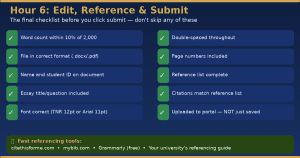
How Do You Reference an Essay Fast?
To reference an essay quickly, use a free citation generator — Cite This For Me (citethisforme.com) or MyBib (mybib.com) — to produce correctly formatted references in your required style in under 20 minutes. Paste in the URL or DOI of each source, select your citation style (Harvard, APA, or MLA), and copy the output into your reference list. Always cross-check the result against your university’s referencing guide — generators occasionally make minor formatting errors.
What Is the Final Checklist Before Submitting an Essay?
Before submitting your essay, check these nine things: word count is within 10% of 2,000 words, file is in the correct format, your name and student ID appear on the document, the essay title or question is included, font and spacing meet your university’s requirements, page numbers are present, your reference list is complete and correctly formatted, the file was saved in the last five minutes, and you have uploaded to the submission portal — not just saved to your desktop. Run through this before you click submit:
- [ ] Word count is within 10% of 2,000 (1,800–2,200 words)
- [ ] File is in the correct format (.docx or .pdf)
- [ ] Your name and student ID are on the document
- [ ] Essay title or question is included
- [ ] Font is correct (usually Times New Roman 12pt or Arial 11pt, double-spaced)
- [ ] Page numbers are included
- [ ] Reference list is complete and properly formatted
- [ ] File saved in the last 5 minutes
- [ ] Uploaded to the submission portal — not just saved to desktop
Submit. Close your laptop. You did it.
The 4-Hour Emergency Plan {#4-hour-plan}
If you have only 4 hours to write your essay, follow this stripped-down timeline: 20 minutes planning, 30 minutes research, 100 minutes writing, 30 minutes on introduction and conclusion, and 40 minutes editing and submitting. Anyone asking how to write a 2000 word essay in one day with fewer than 7 hours needs this version — less research depth, less editing time, but still a complete, submitted essay. 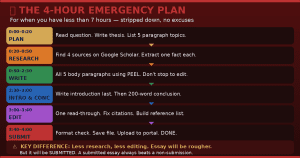
| Time | Task |
|---|---|
| 0:00 – 0:20 | Read question, write thesis, list 5 paragraph topics |
| 0:20 – 0:50 | Find 4 sources on Google Scholar. Extract one key fact from each. |
| 0:50 – 2:30 | Write all 5 body paragraphs using PEEL. Don’t edit. Just write. |
| 2:30 – 3:00 | Write introduction and conclusion |
| 3:00 – 3:40 | Edit for clarity, fix citations, build reference list |
| 3:40 – 4:00 | Final proofread, format check, submit |
What Are the Most Common Last-Minute Essay Mistakes?
The most common last-minute essay mistakes are describing instead of analysing, using Wikipedia as a source, ignoring the word count limit, not reading the essay back before submitting, using the wrong citation format, and writing the introduction before the body paragraphs. Each of these is easy to avoid once you know to look for them. 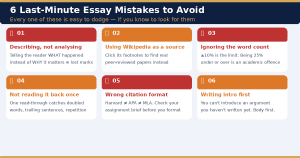
What Is the Difference Between Describing and Analysing in an Essay?
The difference between describing and analysing is that description tells the reader what happened, while analysis tells the reader what it means and why it matters. Lecturers at every UK and US university award marks primarily for analysis — description alone, however accurate, rarely scores above a pass.
Weak (describing): “Smith et al. (2021) found that 45% of students experienced anxiety during the pandemic.” Strong (analysing): “The finding by Smith et al. (2021) that 45% of students experienced anxiety during the pandemic is significant not merely as a statistic, but as evidence that university mental health services were structurally unprepared for a crisis of this scale — a systemic failure with consequences extending well beyond the lockdown period.” The gap between those two sentences is the gap between a 2:2 and a 2:1.
Is It Better to Submit an Unfinished Essay or Miss the Deadline?
It is almost always better to submit an unfinished essay than to miss the deadline entirely. Most UK universities apply a late penalty of 5–10 marks per day, which can still leave a student with a passing grade on a reasonable piece of work. A non-submission typically receives zero with no possibility of recovery. Submit whatever you have.
What If You Keep Ending Up in This Situation?
Knowing how to write a 2000 word essay in one day is a valuable survival skill. But it is not a sustainable strategy for three years of university. If you regularly find yourself in crisis mode at deadlines, the underlying cause is usually one of four things: poor time management, difficulty understanding the subject matter, weak academic writing skills, or stress and burnout. Each of these has a different solution — and treating all four as a time management problem is why the pattern tends to repeat.
For academic writing skills specifically — essay structure, argument construction, and referencing — professional support can make a lasting difference. At KeffEssays, we work with UK and US students who need model essays to understand exactly how a high-quality answer to their specific question should look. Seeing a professionally written essay on your exact brief is one of the fastest ways to close the gap between where your writing is now and where it needs to be. If you’re regularly overwhelmed, it’s also worth speaking to your personal tutor or student support service. Most UK and US universities offer free time management workshops, academic writing centres, and deadline extension policies — resources most students never use.
Free Resources for Writing Better Essays
The best free resources for improving essay writing are Purdue OWL for writing and citation guides, Google Scholar for academic sources, Grammarly for grammar checking, and your university’s academic skills centre for one-to-one support. Using even one of these resources consistently will significantly reduce the likelihood of another last-minute deadline crisis.
- Purdue OWL — the gold standard for academic writing guides, covering every citation style and essay type
- Google Scholar — free access to millions of peer-reviewed academic papers
- Grammarly — free grammar and spell-check (premium version includes plagiarism detection)
- Cite This For Me — free citation generator for Harvard, APA, and MLA formats
- Your university’s academic skills centre — almost every UK and US university offers free one-to-one essay support. Most students never use it. Use it.
Frequently Asked Questions
Can you write a 2000 word essay in one day? Yes, you can write a 2000 word essay in one day. At average typing speed, the writing itself takes under an hour. The full process — planning, researching, writing, and editing — takes 5–7 hours of focused work. The key is following a structured plan from the start rather than writing and deleting in circles.
How many paragraphs is a 2000 word essay? A 2000 word essay typically has 7–8 paragraphs: a 200-word introduction, five body paragraphs of approximately 300 words each, and a 200-word conclusion. Each body paragraph should make one clear point supported by evidence and critical analysis.
How many sources do you need for a 2000 word essay? A 2000 word essay typically requires 6–8 sources at UK university level. Under time pressure, 5 solid academic sources from Google Scholar or your university library is a workable minimum.
How do you stop procrastinating and start writing? Set a timer for 25 minutes and write anything — even rough, incomplete sentences. The act of writing generates momentum. The blank page is always the hardest part. Once you have 200 words on the screen, the rest follows significantly more easily.
What is the fastest way to write an essay? The fastest way to write an essay is to plan your argument completely before writing a single word of the essay itself. Students who spend 30–45 minutes planning before they write consistently produce first drafts faster and with fewer rewrites than students who start typing immediately.
Is it better to submit an unfinished essay or miss the deadline? It is almost always better to submit an unfinished essay than to miss the deadline. Most UK universities apply late penalties of 5–10 marks per day, which still allows for a passing grade. A non-submission typically receives zero with no recovery possible.
How do you write a 2000 word essay in 4 hours? To write a 2000 word essay in 4 hours: spend 20 minutes planning, 30 minutes on a fast research sprint, 100 minutes writing body paragraphs using PEEL, 30 minutes on your introduction and conclusion, and 40 minutes editing, referencing, and submitting. The essay will be rougher than a 7-hour version — but it will be complete and submitted on time.
The Bottom Line
To write a 2000 word essay in one day, follow this six-step process: analyse the question and write a one-sentence thesis, plan five body paragraph topics in bullet points, complete a 60-minute research sprint for 5 solid sources, write all body paragraphs using PEEL structure, write your introduction and conclusion last, then edit, reference, format, and submit. This is the complete method. Every other detail in this guide supports these six steps. You searched for how to write a 2000 word essay in one day because you’re in crisis.
Here’s what matters: this is survivable. Not comfortable, not ideal — but entirely doable. You have the method. You have the tools. You have enough hours. Stop reading. Start writing. And if you need support — a model essay to learn from, guidance on structure, or help understanding what your lecturer is actually looking for — the team at KeffEssays is available around the clock. You’ve got this. Now go.
Need more study support? Read our guide on How to Write a First-Class Essay in the UK or learn Everything About APA, MLA, and Harvard Referencing.