
You’re not broken. You’re not behind. You’re a university student in the middle of midterm season — and right now, that is one of the most genuinely overwhelming experiences a person can go through, so do you want to know how to reduce midterm stress UK students?
UK and US students are currently reporting record levels of exam anxiety. A 2025 survey by Student Minds found that over 68% of UK university students experience significant psychological distress during assessment periods. At elite institutions like Oxford and Cambridge, students describe preparing for exams as “a kind of controlled panic” — always present, always threatening to spiral.
This guide is not about toxic positivity or vague advice like “just sleep more.” It’s about seven specific, evidence-backed strategies that help you reduce midterm stress right now — not after you’ve finished your degree.
And if the workload itself is what’s crushing you — the actual essays, assignments, and coursework piling up alongside your revision — we’ll address that too.
How to reduce Midterm Stress UK Students and why it hits UK and US students So Hard
Before the strategies, it helps to understand what’s actually happening. Midterm stress isn’t weakness — it’s a predictable collision of:
- Multiple deadlines landing simultaneously — coursework, presentations, and exams all scheduled within days of each other
- Sleep debt from term-long overwork — most students arrive at midterms already running on empty
- Isolation from support systems — friends are equally overwhelmed, family don’t fully understand the pressure
- The comparison trap — everyone around you appears to be coping fine. Most of them aren’t.
- High-stakes thinking — catastrophising that one exam will define your entire career
Recognising these triggers is the first step to dismantling them and knowing how to reduce midterm stress uk students. Now, the strategies.
Strategy 1: Do the Anxiety Audit Before You Do Anything Else
When everything feels urgent, nothing actually gets done. The anxiety audit takes ten minutes and cuts through the noise.
Write down every single thing you’re worried about — exams, assignments, emails you haven’t replied to, conversations you’re avoiding. Get it all out of your head and onto a page.
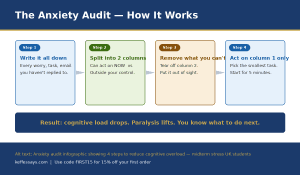
Then separate the list into two columns: things you can act on right now, and things outside your control. Tear off the second column and put it somewhere you can’t see it.
Your brain cannot distinguish between a genuine threat and a perceived one. This process physically reduces the cognitive load your nervous system is carrying.
Strategy 2: Stop Revising Everything — Prioritise by Exam Weight
One of the biggest sources of midterm stress is treating every module as equally important. They’re not.
Pull up your module handbooks and list each assessment by its percentage of your final grade. A midterm exam worth 15% of a module that represents 20% of your degree deserves far less of your mental energy than a dissertation component worth 40%.
The QAA (Quality Assurance Agency for Higher Education) framework gives every UK institution guidelines on weighting — use this knowledge strategically. Triage your revision like a doctor triaging patients: highest stakes first, lowest stakes last or not at all.
Strategy 3: Use the 25/5 Method — Not the All-Nighter
The research on this is unambiguous. A 2024 study published on PubMed confirmed that spaced, time-limited study sessions produce significantly better memory consolidation than marathon revision sessions.
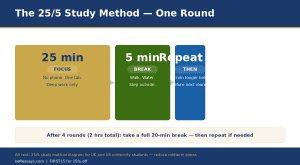
The method is simple:
- 25 minutes of focused work — phone in another room, one tab open, nothing else
- 5 minute real break — walk, water, outside if possible
- After four rounds, take a 20-minute break
- Stop completely after six hours of total study — anything beyond this has diminishing returns
All-nighters feel productive. They aren’t. They impair the very memory consolidation you’re trying to achieve.
Strategy 4: Use the 4-7-8 Breathing Technique During Panic Moments
When exam anxiety peaks — sitting in a seminar room the morning before an exam, lying awake at 3am, opening your revision notes and feeling your chest tighten — your body has activated its fight-or-flight response.
The 4-7-8 breathing technique, developed at the University of Arizona and now recommended by the NHS for anxiety management, directly counteracts this:
- Inhale quietly through your nose for 4 seconds
- Hold your breath for 7 seconds
- Exhale completely through your mouth for 8 seconds
- Repeat four cycles
This is not mindfulness-speak. The extended exhale activates the parasympathetic nervous system — your body’s actual off-switch for the stress response. Use it before exams, before sitting down to revise, and any time you feel the panic rising.
Strategy 5: Separate Exam Revision from Written Assignment Stress
A significant proportion of how to reduce midterm stress uk students isn’t about exams at all — it’s about the essays, reports, and coursework assignments running simultaneously with your revision.
These are two completely different cognitive tasks, and treating them as one undifferentiated mountain of work is a major source of paralysis. Separate them entirely:
- Morning blocks (before noon): written assignments — these require your freshest thinking
- Afternoon blocks: exam revision — consolidation and practice questions
- Evening (if needed): light review only — flashcards, key terms, nothing cognitively demanding
If written assignments are the bigger source of your stress right now — and for many students they are — it’s worth knowing that KeffEssays specialises in exactly this. Our UK and US qualified writers provide model essays, coursework samples, and assignment support with 24-hour turnaround for students who simply cannot do everything at once. Use code KE15 for 15% off your first order.
Strategy 6: Tell Someone — But Choose Who Carefully
Isolation amplifies midterm stress. Research from Student Space consistently shows that students who verbalise their stress to at least one trusted person report significantly lower anxiety levels within 48 hours — not because anything changes, but because the brain processes externalised language differently to internal rumination.
Who you tell matters:
- Best: A friend outside your course who can listen without competing or comparing
- Good: Your university’s counselling service — most UK universities offer same-week appointments during assessment periods
- Use carefully: Course mates — useful for practical problem-solving, but can increase anxiety through comparison
- Avoid: Social media — stress-posting amplifies rather than releases
You do not need to handle midterm season alone. Most UK universities have dedicated mental health and wellbeing teams — Student Minds also provides a 24/7 crisis line if stress escalates beyond manageable levels.
Strategy 7: Reframe What a Good Performance Actually Means
The most damaging “how to reduce midterm stress uk students” comes from a cognitive distortion that researchers call catastrophic thinking — the belief that one exam, one assignment, or one bad week will permanently derail your academic future.
It won’t.
UCAS data consistently shows that employers and postgraduate programmes care far more about the trajectory of your performance than any individual result. A 2:1 from a student who struggled in second year and recovered is often viewed more favourably than a flat 2:1 with no visible growth.
Midterms are diagnostics, not verdicts. They exist to show you where your understanding is solid and where it needs work before finals — use them for that, and the performance anxiety shifts significantly. If your dissertation is adding to the pressure, or you need help with how to write a first class essay, our blog has free guides for both.
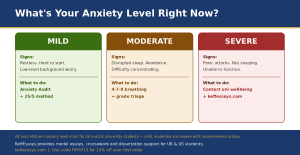
Midterm Anxiety Levels vs. What to Do: Quick Reference
| Anxiety Level | Signs | Best Action |
|---|---|---|
| Mild | Restless, finding it hard to start, low-level worry | Anxiety audit + 25/5 method. You just need a start point. |
| Moderate | Disrupted sleep, difficulty concentrating, avoidance | Breathing technique + triage strategy. Tell someone today. |
| Severe | Panic attacks, not sleeping, crying, unable to function | Contact university wellbeing + Student Minds. Offload written work to keffessays.com immediately. |
Frequently Asked Questions
How long does midterm stress last for university students? For most UK and US students, the acute phase of midterm stress lasts 2–4 weeks — the period immediately before and during assessment. Stress that extends significantly beyond the assessment period, or that is severe enough to affect daily functioning, warrants a conversation with your university’s counselling team or GP.
Is it normal to have a panic attack before exams? Yes — exam-triggered panic attacks are far more common than reported, because students rarely disclose them. If you experience racing heart, difficulty breathing, or overwhelming dread before assessments, you’re not alone and you’re not abnormal. The 4-7-8 breathing technique in Strategy 4 above is specifically designed for this moment.
What should I do if I can’t get started on any revision at all? Start with the anxiety audit (Strategy 1). Paralysis usually signals cognitive overload, not laziness — your brain has too many competing priorities and has frozen rather than choose. Getting everything out of your head and onto paper often breaks the deadlock within minutes. If paralysis persists, the issue may be written assignments compounding revision pressure — KeffEssays can take the essay workload off your plate entirely so you can focus on exams.
Can stress actually affect my exam performance? Yes — but the relationship is not linear. Moderate stress improves performance by increasing focus and motivation (the Yerkes-Dodson curve). It’s high and unmanaged stress that tanks performance by impairing working memory and retrieval. The strategies above are designed to keep you in the optimal zone, not to eliminate stress entirely.
Further Reading from KeffEssays
If midterm season has you stretched across multiple deadlines, these free guides may help:
- How to Write a 2,000-Word Essay in One Day — fast essay strategy for tight deadlines
- How to Write a First Class Essay UK — structure, argument and marking criteria
- Dissertation Stress UK Students — if the dissertation is the real source of pressure
- APA vs MLA vs Harvard Referencing — stop losing marks on citation style
- How to Write a UCAS Personal Statement — if applications are adding to your workload
Over to You
Which of these seven strategies are you going to try first? And what’s the biggest thing making midterm season difficult for you right now — is it the revision itself, the written assignments running alongside it, or something else entirely? Drop your answer in the comments below.
Need to take written assignments off your plate entirely? KeffEssays provides model essays, coursework, and dissertation support for UK and US university students — written by degree-qualified native English speakers, delivered in 24 hours, plagiarism-free. Use code KE15 for 15% off your first order: Order now!