

You have been staring at a blank document for three hours. The word count reads zero. Your dissertation is due in weeks — or days — and you have no idea where to actually begin.
If that is you right now, you are not failing. You are experiencing exactly what thousands of UK students face every single year. The dissertation is unlike any assignment you have written before. It is longer, entirely self-directed, and carries more weight toward your final degree classification than anything else you will submit.
The students who finish strong are not necessarily the most talented writers in their cohort. They are the students who understand how to structure their dissertation correctly from the very beginning — and that is exactly what this guide will give you.
What Makes a UK Dissertation Different From an Essay
Most UK students arrive at their dissertation having only written essays and coursework assignments. The dissertation feels overwhelming because it operates on a completely different scale — and by completely different rules.
Unlike standard essays, a UK dissertation requires you to design and conduct original research, manage your own project timeline across months rather than weeks, and demonstrate independent scholarly thinking at a level that shorter assignments never demand.
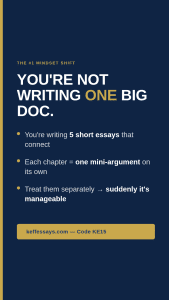
The most important mindset shift for dissertation help UK students need to make: you are not writing one enormous document. You are writing five or six separate, manageable pieces of academic work that connect into a coherent whole. Think of each section as a mini-essay — each should introduce its content, develop it, and conclude before moving on.
Universities in the UK set specific word limits by academic level. Undergraduate dissertations typically range from 8,000 to 12,000 words. Master’s dissertations are often 10,000 to 15,000 words, with research-intensive programmes sometimes reaching 20,000 to 30,000 words.
Always check your university’s dissertation handbook for exact requirements. The UK Quality Code for Higher Education (QAA) sets the academic standards all UK universities must meet — understanding these standards will help you appreciate exactly what your examiners are looking for.
The Complete UK Dissertation Structure
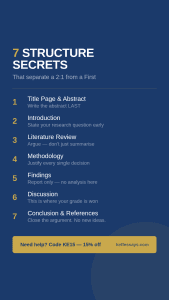
The standard UK dissertation structure includes the following components. Understanding what each one does — and why — is the foundation of every structure secret in this guide.
- Title Page
- Abstract
- Acknowledgements
- Table of Contents
- List of Figures and Tables (if applicable)
- Introduction
- Literature Review
- Methodology
- Findings and Results
- Discussion
- Conclusion
- References
- Appendices
The structure can vary depending on your course. Some programmes include the literature review as a standalone chapter; others embed it within the introduction. Always check your university’s specific requirements before you begin.
Secret 1: The Title Page and Abstract — First Impressions Matter
Your title page is the first thing your examiner sees. It needs to be clean, professional, and formatted exactly to your university’s requirements. It includes your dissertation title, your name, department, institution, degree programme, and submission date.
Your title should be specific and descriptive. Avoid vague titles like “An Investigation into Leadership.” Be precise: “Transformational Leadership Styles in UK Retail Organisations: A Qualitative Study of Manager Perceptions.”
For your abstract, aim for 250–300 words. It should cover four things: your research question, your methodology, your key findings, and your conclusion.
The most important rule about the abstract: Write it last. You cannot summarise a dissertation you have not yet finished. Leave a blank space for it at the top of your document and come back to it once everything else is complete.
If the pressure of your dissertation is becoming genuinely overwhelming, Student Minds is the UK’s leading student mental health charity — their resources are free and genuinely helpful.
Secret 2: The Introduction Chapter — Set Your Direction First

The introduction is where most UK students lose unnecessary marks. They write it first, they write it too broadly, and they never go back to sharpen it after the rest of the dissertation is complete.
Your introduction must do four specific things:
- Establish the background. Give your reader the context they need to understand your topic. Two or three focused paragraphs is sufficient. This is not the literature review — save detailed analysis of existing research for chapter two.
- State your research question. Be precise. Your entire dissertation is an attempt to answer one central question. State it clearly and early.
- Explain why it matters. What gap in existing knowledge does your research address? What contribution does it make to your field?
- Outline the structure. Tell your examiner exactly what is coming in each chapter that follows.
Word count guidance: For a 10,000-word dissertation, aim for 800–1,000 words. For a 15,000-word dissertation, aim for 1,000–1,500 words.
Secret 3: The Literature Review — This Is an Argument, Not a Summary
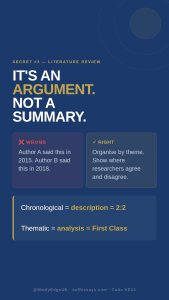
The literature review is the chapter where most UK students underperform — almost always for the same reason. They treat it as a summary of what other researchers have said, rather than as a critical argument.
Your literature review has a specific job: to show your examiner that you understand the existing research landscape, can identify where gaps or disagreements exist, and can position your own research within that context.
How to structure your literature review:
- Start broad and narrow down. Begin with wider theoretical context, then narrow to studies most directly relevant to your research question. End by identifying the exact gap your dissertation addresses.
- Organise by theme, not by author or date. A thematic structure shows analytical thinking. A chronological “Author A said this in 2015, Author B said this in 2018” structure shows description — and description earns you a 2:2, not a first.
- Use Harvard referencing consistently unless your university specifies otherwise.
For UK referencing standards, the University of Leeds Library Academic Writing Guide is one of the most comprehensive free resources available to students across all disciplines.
Managing your references properly is non-negotiable. Zotero is a free reference management tool that automatically formats citations in Harvard, APA, OSCOLA, and every other major style — use it from day one of your literature review.
Word count guidance: The literature review carries approximately 30% of your total word count. For a 10,000-word dissertation that is 2,500–3,000 words.
Secret 4: The Methodology Chapter — Justify Every Decision
The methodology chapter is the one UK students most frequently underestimate. They treat it as an administrative chapter — a brief box-ticking exercise before the interesting findings. This is a critical mistake.
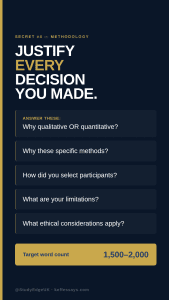
Your methodology chapter does two things simultaneously: it explains what you did and it justifies why you did it. Every research decision you made needs a clear rationale.
The key questions your methodology chapter must answer:
- Is your research qualitative, quantitative, or mixed methods — and why?
- What methods did you use to collect data — interviews, surveys, experiments, archives — and why are these appropriate?
- Who are your participants or sources, and how did you select them?
- What are the limitations of your methodology?
- What ethical considerations apply to your research?
Word count guidance: The methodology should be approximately 15–20% of your total word count. For a 10,000-word dissertation that is 1,500–2,000 words.
Secret 5: The Findings Chapter — Report First, Analyse Later
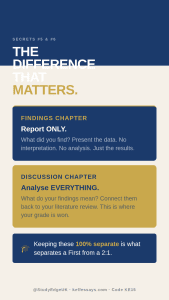
This is the chapter where UK students most consistently blur two things that must remain completely separate: findings and analysis.
Your findings chapter has one job: present what you found. Not what it means. Not why it matters. Simply what your research produced.
If you conducted interviews, present the themes that emerged. If you ran surveys, present the data. If you conducted experiments, present the results. In every case, report objectively. The analysis and interpretation belong in the discussion chapter.
This distinction is one of the clearest markers between a 2:1 and a first-class dissertation. Students who merge findings and discussion demonstrate confused thinking. Students who separate them cleanly demonstrate academic rigour.
Practical tips:
- Use tables, graphs, and figures where they genuinely add clarity — but reference every visual element in the text immediately below it.
- For qualitative research, use brief direct quotes from interviews to illustrate your themes — keep them short.
- Never drop a graph into your dissertation without explaining it in writing.
Before you submit your findings chapter — or any chapter — run it through Grammarly. The free version catches grammar issues and readability problems that spell-check misses.
Word count guidance: Aim for 15–20% of your total word count. For a 10,000-word dissertation that is 1,500–2,000 words.
Secret 6: The Discussion Chapter — Where Your Grade Is Won or Lost
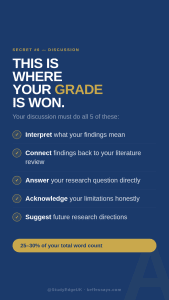
If the findings chapter is the most misunderstood, the discussion chapter is the most important. This is where your analytical ability is fully tested — and where the difference between a first and a 2:1 is most clearly visible.
Your discussion chapter interprets your findings in relation to your research question and the existing literature you reviewed in chapter two. It is the intellectual heart of your entire dissertation.
What your discussion chapter must do:
- Interpret what your findings actually mean
- Connect your findings back to the literature review — do your results support, contradict, or extend existing research?
- Address your research question directly
- Acknowledge the limitations of your research honestly
- Suggest directions for future research
The most common discussion chapter mistake is simply restating the findings. “The results showed X” is not analysis. “The results showed X, which contradicts Author B’s 2019 finding that Y — this may be explained by the difference in sample size and geographical context” is analysis.
Word count guidance: The discussion chapter carries 25–30% of your total word count. For a 10,000-word dissertation that is 2,000–2,500 words.
Secret 7: The Conclusion and References — Finish Strong
Your conclusion is not a summary — or rather, it is a summary, but it is also more than that. Your conclusion must do four things:
- Restate your research question. Remind your examiner what you set out to investigate.
- Summarise your key findings. Not the detail — the headline result. What did your research ultimately find?
- Answer the research question directly. This is the single most important sentence in your entire dissertation. After everything you have researched and written, what is your answer to the question you posed in your introduction?
- Recommend future research. What questions remain unanswered? What would a follow-up study investigate?
Keep your conclusion tightly focused. Aim for 500–800 words. Do not introduce new arguments or new literature. The conclusion is the place for closure, not new ideas.
For your references: use your university’s required citation style consistently throughout. Harvard is the most common in UK universities, but OSCOLA is standard in law, Vancouver in medicine, and APA in psychology and social sciences.
Every source cited in your text must appear in your reference list — and every entry in your reference list must be cited in your text. Use Scribbr’s free Harvard referencing guide to check your citations before submitting.
UK Dissertation Word Count Breakdown by Level
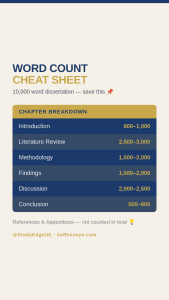
Use this as your planning template. These are average guidelines — always verify against your specific university handbook.
Undergraduate Dissertation — 10,000 words
| Chapter | Word Count Target |
|---|---|
| Introduction | 800–1,000 words |
| Literature Review | 2,500–3,000 words |
| Methodology | 1,500–2,000 words |
| Findings | 1,500–2,000 words |
| Discussion | 2,000–2,500 words |
| Conclusion | 500–800 words |
| References | Not counted in total |
| Appendices | Not counted in total |
Master’s Dissertation — 15,000 words
| Chapter | Word Count Target |
|---|---|
| Introduction | 1,000–1,500 words |
| Literature Review | 4,000–4,500 words |
| Methodology | 2,000–2,500 words |
| Findings | 2,500–3,000 words |
| Discussion | 3,000–3,500 words |
| Conclusion | 800–1,000 words |
| References | Not counted in total |
| Appendices | Not counted in total |
The Most Common Structural Mistakes UK Students Make
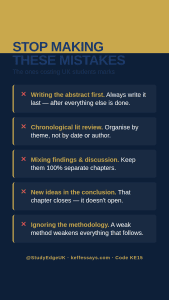
- Writing the abstract first. Write it last. Always.
- Using a chronological literature review. Organise by theme, not by date or author.
- Mixing findings and discussion. Keep them completely separate.
- Not connecting the discussion back to the literature review. Your chapter two and chapter five must speak to each other.
- A conclusion that introduces new arguments. Close the argument — do not open new ones.
- Inconsistent referencing. Check every citation before submitting.
- Ignoring the methodology word count. A weak methodology weakens every chapter that follows it.
When to Get Professional Dissertation Help UK Students Can Trust
There are moments in every dissertation where the right decision is to ask for help. Recognising those moments is not a sign of weakness — it is a sign of strategic thinking.
If your deadline is approaching and you are significantly behind, if you are struggling with a specific chapter, or if you need a model example of what a well-structured UK dissertation looks like — keffessays.com is here.
Our writers hold degrees from UK universities including UCL, University of Leeds, University of Manchester, and more. Every piece of work is original, plagiarism-free, and includes a Turnitin report. Whether you need a complete dissertation, a single chapter, a literature review, or a methodology section — we are available right now.
FAQ
What is the standard structure of a UK dissertation?
A standard UK dissertation structure includes a title page, abstract, acknowledgements, table of contents, introduction, literature review, methodology, findings, discussion, conclusion, references, and appendices. The exact structure varies by university and subject area, so always check your dissertation handbook before you begin writing.
How many words should each chapter of my UK dissertation be?
For a 10,000-word undergraduate dissertation, the literature review is typically the longest chapter at 2,500–3,000 words, followed by the discussion at 2,000–2,500 words. The introduction and conclusion are shorter at 800–1,000 and 500–800 words respectively. For a 15,000-word master’s dissertation, scale these figures proportionally. Always verify against your university’s specific guidelines.
What is the difference between the findings chapter and the discussion chapter?
The findings chapter presents what your research produced — data, themes, or results — without interpretation. The discussion chapter then analyses what those findings mean, connects them to the existing literature, and addresses your research question. Keeping these two chapters clearly separate is one of the most important structural decisions in your entire dissertation.
When should I write my dissertation abstract?
Always write your abstract last, even though it appears first in your submitted document. The abstract is a 250–300 word summary of your research question, methodology, key findings, and conclusion. You cannot write an accurate summary until the full dissertation is complete.
What is the biggest challenge you have faced with your dissertation structure? Drop it in the comments below and we will help you work through it 👇