
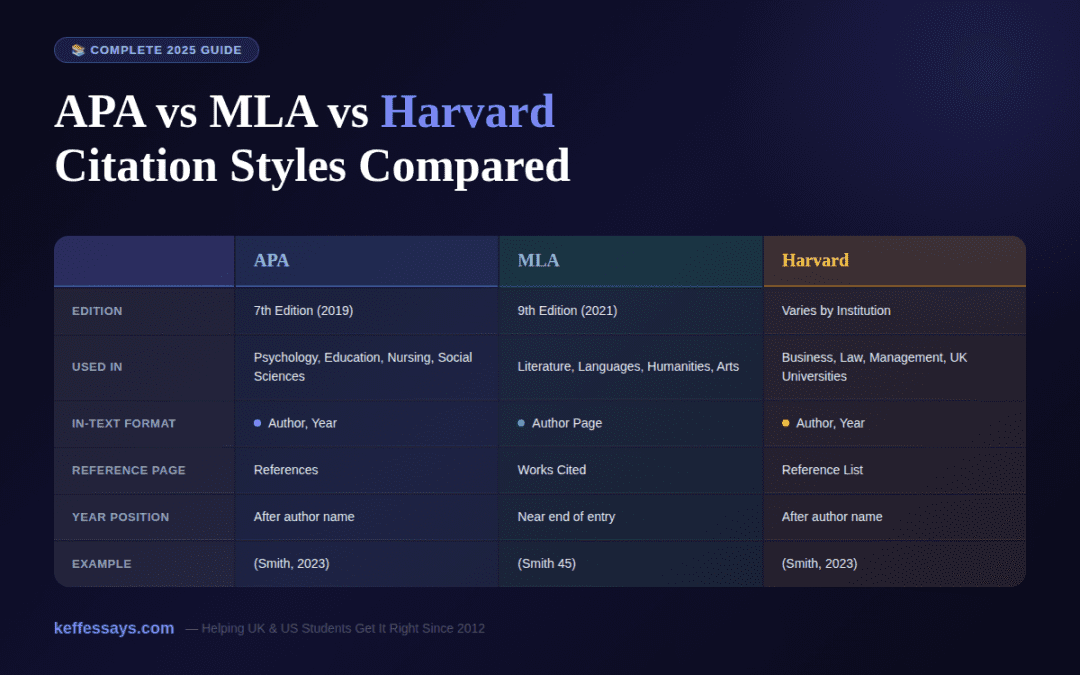
Every student has been there. You’ve written a solid essay, you’ve done the research, and now you’re staring at your reference list wondering: should this be APA, MLA, or Harvard? Get it wrong, and it doesn’t just look unprofessional — it can cost you actual marks.
Understanding APA vs MLA vs Harvard citation is one of the most practical skills you can develop as a student, yet most universities do a terrible job of explaining it clearly. Different modules across the same degree can require different styles. One week you’re using Harvard referencing for your sociology essay, the next you’re switching to APA for your psychology report — and suddenly you’ve forgotten which goes where.
This complete guide breaks down APA vs MLA vs Harvard citation in plain English. We’ll cover what each style is, which subjects use it, exactly how to format your in-text citations and reference lists, common mistakes to avoid, and a simple decision framework so you never have to guess again.
Why Citation Style Actually Matters (More Than You Think)
Before we dive into the specifics of APA vs MLA vs Harvard citation, let’s quickly cover why this matters beyond just following rules.
Referencing is not a formality. It is the academic backbone of your argument. When you cite a source correctly, you are doing three things simultaneously: you are giving credit to the original researcher, you are directing your reader to the evidence supporting your claim, and you are demonstrating to your lecturer that you can engage credibly with academic literature.
Minor formatting errors in citations can cost assignment points, and using the wrong style signals to your marker that you did not follow instructions carefully. In more serious cases, missing or incorrect citations can be flagged as potential plagiarism — even when no dishonesty was intended.
The stakes are high. The good news is that once you understand the logic behind each style, the formatting rules start to make sense rather than feeling like arbitrary torture. For a useful benchmark on academic integrity, the University of Oxford’s referencing and plagiarism guidance is an excellent starting point.

What Is APA Citation Style?
APA stands for the American Psychological Association, and the current version is APA 7th Edition, published in 2019. APA is primarily used in social sciences, psychology, education, and business.
The philosophy behind APA is recency. In fields like psychology, nursing, and education, a study from ten years ago may carry significantly less weight than one published last year. For this reason, the year of publication is given the highest priority in both in-text citations and the final reference list in APA style.
APA In-Text Citation Format
The APA format uses an author-date system in parentheses.
- Paraphrase: (Smith, 2023)
- Direct quote with page number: (Smith, 2023, p. 45)
- Narrative citation: Smith (2023) found that…
- Two authors: (Smith & Johnson, 2023)
- Three or more authors: (Smith et al., 2023)
APA Reference List Format
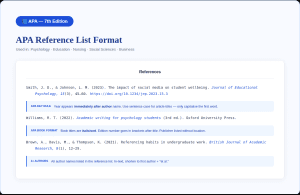
Your reference list in APA goes at the end of your paper under the heading References (centred, bold). Each entry follows this structure for a journal article:
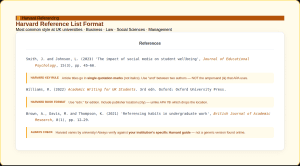
Smith, J. D., & Johnson, L. M. (2023). The impact of social media on student wellbeing. Journal of Educational Psychology, 15(3), 45–60. https://doi.org/10.1234/jep.2023.15.3.45
Key APA rules to remember:
- Use sentence case for article and book titles (only capitalise the first word and proper nouns)
- Italicise the journal name and volume number
- Always include DOI or URL for online sources
- The year appears immediately after the author’s name
- APA papers typically require a formal title page
For the full official APA formatting rules, the APA Style official website is the most authoritative and up-to-date resource available.
What Is MLA Citation Style?
MLA stands for the Modern Language Association, and the current version is MLA 9th Edition, released in 2021. MLA is commonly used in humanities disciplines including literature, languages, history, and the arts.
The philosophy behind MLA is completely different from APA. Rather than prioritising when something was published, MLA prioritises who wrote it and where in the text the specific passage appears. This makes sense for literature essays — when you’re analysing a line of Shakespeare, your reader needs to be able to find the exact passage, not know when Shakespeare was born.
MLA In-Text Citation Format
MLA uses an author-page system in parentheses.
- Paraphrase: (Smith 45)
- Direct quote: (Johnson 112)
- Three or more authors: (Smith et al. 78)
- No author: Use a shortened title instead
Notice that there is no year in MLA in-text citations. This is the single biggest difference between MLA and the other two styles, and it trips up students constantly when switching between formats.
MLA Works Cited Format
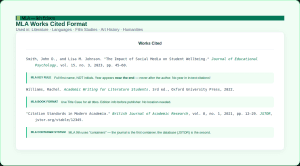
Your reference list in MLA is called a Works Cited page (not References, not Bibliography). For a journal article, it follows this structure:
Smith, John D., and Lisa M. Johnson. “The Impact of Social Media on Student Wellbeing.” Journal of Educational Psychology, vol. 15, no. 3, 2023, pp. 45–60.
Key MLA rules to remember:
- Use Title Case for article and book titles (capitalise every major word)
- The author’s full first name is spelled out (not initials like in APA)
- The year appears near the end of the entry, not immediately after the author
- MLA 9th Edition uses a “container” system — if you found an article in a journal, the journal is the container; if you found it on a database like JSTOR, JSTOR is the second container
- MLA papers do not typically require a title page
The MLA Style Center is the official home for MLA formatting guidance and is updated regularly with examples for new media types including websites, podcasts, and social media.
What Is Harvard Citation Style?
Harvard referencing is slightly different from APA and MLA in one important way: Harvard is not a single standardised style owned by one organisation — it is a broad family of author-date formats used primarily in UK and Australian universities, with variations existing between institutions.
This is why students often find Harvard confusing. Your university’s version of Harvard referencing may look slightly different from another institution’s version, and both could technically be correct. Always check your university’s specific Harvard guide rather than relying on a generic one found online.
Harvard is extremely common across UK universities and is used in disciplines including business, law, management, social sciences, and humanities — making it the most versatile of the three styles covered in this guide.
Harvard In-Text Citation Format
Like APA, Harvard uses an author-date system. The format looks almost identical to APA at first glance:
- Paraphrase: (Taylor, 2021)
- Direct quote: (Taylor, 2021, p. 89)
- Two authors: (Taylor and Wilson, 2021)
- Three or more authors: (Taylor et al., 2021)
The subtle differences from APA include punctuation and how multiple authors are connected. APA uses an ampersand (&) between two authors in parentheses; Harvard typically spells out “and.”
Harvard Reference List Format
Your reference list in Harvard appears at the end of the paper simply under the heading References or Reference List. For a journal article:
Taylor, J. and Wilson, K. (2021) ‘Introduction to referencing for UK students’, British Journal of Education, 18(2), pp. 33–48.
Key Harvard rules to remember:
- Article titles are placed in single quotation marks (not italics)
- Book and journal titles are italicised
- “pp.” is used before page number ranges
- Because there is no central official manual, consistency within your document is crucial — follow your own university’s Harvard guide throughout
- Harvard is the most common referencing style at UK universities
Since there is no single official Harvard manual, the UCL Library Harvard Referencing Guide is one of the most widely trusted and comprehensive versions used across UK universities.
APA vs MLA vs Harvard Citation: Side-by-Side Comparison
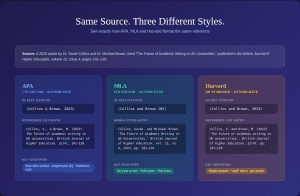
To make the APA vs MLA vs Harvard citation differences crystal clear, here is a direct comparison using the same fictional source across all three styles:
Source: A 2023 article by Dr. Sarah Collins and Dr. Michael Brown, titled “The Future of Academic Writing in UK Universities,” published in the British Journal of Higher Education, volume 22, issue 4, pages 101–120.
APA (7th Edition)
In-text: (Collins & Brown, 2023)
Reference list: Collins, S., & Brown, M. (2023). The future of academic writing in UK universities. British Journal of Higher Education, 22(4), 101–120.
MLA (9th Edition)
In-text: (Collins and Brown 105)
Works Cited: Collins, Sarah, and Michael Brown. “The Future of Academic Writing in UK Universities.” British Journal of Higher Education, vol. 22, no. 4, 2023, pp. 101–120.
Harvard
In-text: (Collins and Brown, 2023)
Reference list: Collins, S. and Brown, M. (2023) ‘The future of academic writing in UK universities’, British Journal of Higher Education, 22(4), pp. 101–120.
Notice how the in-text citations for Harvard and APA look almost identical, while MLA stands out immediately because it has no year and uses the page number instead. In the reference lists, MLA uses the author’s full first name, while APA and Harvard use initials only. These small differences matter enormously when your marker is checking your work.
Which Citation Style Should You Use? A Simple Decision Framework
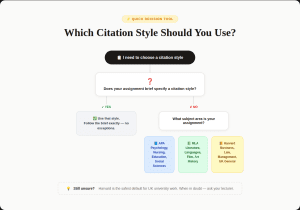
This is the question at the heart of every student’s confusion about APA vs MLA vs Harvard citation. Here is a straightforward framework:
Step 1: Check your assignment brief first. Your module guide or assignment instructions will almost always specify a citation style. If it does, use that style — full stop. Do not second-guess it.
Step 2: If your brief doesn’t specify, check your department’s guidance. Most UK universities publish referencing guidance on their library or student portal pages. Your department may have a preference even if individual assignments don’t state one.
Step 3: If you still have no guidance, use your subject area as a guide:
- Psychology, Education, Nursing, Social Work, Business (research papers): Use APA
- Literature, Languages, Film Studies, Art History, Cultural Studies: Use MLA
- Business, Law, Management, Sociology, History, General UK/Australian university work: Use Harvard
- Interdisciplinary subjects or anything at a UK university without clear guidance: Harvard is your safest default
Step 4: When genuinely in doubt — ask your lecturer. This is not a sign of weakness. Lecturers would much rather you send a quick email than submit an assignment in the wrong format.
The 7 Most Common Citation Mistakes Students Make (And How to Fix Them)
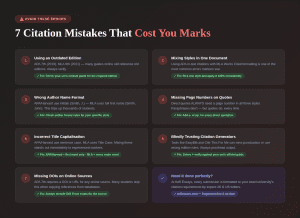
Even students who understand APA vs MLA vs Harvard citation in theory regularly lose marks to avoidable errors. Here are the most frequent mistakes and exactly how to fix them:
1. Using the Wrong Edition
APA published its 7th edition in 2019, MLA released its 9th edition in 2021, and Chicago published its 18th edition in 2024. Updates refine existing rules and add guidance for new media types. Many students are still following older guides found online. Always verify which edition your institution requires.
2. Mixing Styles Within One Document
Switching between APA in-text citations and MLA Works Cited formatting in the same essay is one of the most common errors markers see. Pick one style and apply it consistently from your first citation to your last reference list entry.
3. Getting Author Name Format Wrong
- APA: Last name, first initial only (Smith, J.)
- MLA: Full first name spelled out (Smith, John)
- Harvard: Last name, first initial (Smith, J.)
This small difference trips up thousands of students every year.
4. Forgetting Page Numbers on Direct Quotes
Whenever you quote directly from a source — copying exact words — all three styles require a page number. Paraphrasing does not always require a page number, but direct quotation always does.
5. Incorrect Capitalisation of Titles
- APA and Harvard: Sentence case for article titles (only first word and proper nouns capitalised)
- MLA: Title case (every major word capitalised)
Mixing these up is an extremely common error that stands out immediately to experienced markers.
6. Blindly Trusting Citation Generators
Tools like Cite This For Me, EasyBib, or Zotero are helpful starting points, but citation tools can sometimes miss parts or punctuation — always review the output against your university’s official guide before submitting.
7. Missing DOIs on Online Sources
Modern APA 7th edition expects a DOI (Digital Object Identifier) or URL for any source accessed online. Many students skip this, especially when copying references from databases. If a DOI exists, include it.
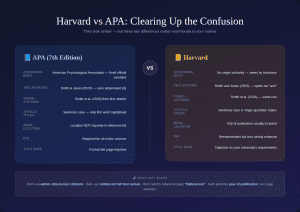
Harvard vs APA: Clearing Up the Confusion
Because APA vs MLA vs Harvard citation comparisons often get muddled between Harvard and APA specifically, this section addresses the most frequently asked questions directly.
Is Harvard the same as APA?
Both use author-date citations, but APA has very specific formatting rules, fixed heading structures, and specific punctuation requirements, while Harvard varies between institutions and is more flexible. They look similar in in-text citations but differ in reference list formatting, particularly around punctuation, capitalisation, and how journal information is presented.
Which is harder — APA or Harvard?
APA is more prescriptive, which makes it both harder (more rules to learn) and easier (less ambiguity once you know the rules). Harvard is more flexible but that flexibility means you need to be very familiar with your specific university’s version.
Why does my UK university use Harvard instead of APA?
Harvard citation style is widely used at institutions of higher learning in the UK, particularly in fields such as business, law, management, and social sciences. It predates APA as a standard for UK academic writing and remains embedded in UK academic culture.
Free Tools to Help You Cite Correctly
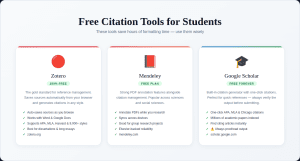
Understanding APA vs MLA vs Harvard citation theory is important, but you also need practical tools to implement it efficiently. Here are the most reliable free options:
Zotero (zotero.org) — The gold standard for free reference management. Zotero automatically saves sources from your browser, organises them, and generates citations in any style. It integrates directly with Microsoft Word and Google Docs. Highly recommended for dissertations and research-heavy assignments.
Mendeley (mendeley.com) — Similar to Zotero, with strong PDF annotation features. Popular in sciences and social sciences.
Google Scholar (scholar.google.com) — Google Scholar has a built-in citation generator. Click the quotation mark icon under any search result to get an instant citation in APA, MLA, or Chicago format. Use this as a starting point, but always verify.
Cite This For Me / Scribbr — Web-based citation generators that are quick for one-off references. More prone to errors than Zotero for longer reference lists, so always proofread the output.
Your university library almost certainly also has its own citation guidance pages, often with examples tailored to your specific institution’s version of Harvard. These are your most reliable resources.
When Should You Ask for Professional Help?
Understanding the theory behind APA vs MLA vs Harvard citation is one thing. Applying it correctly across a 5,000-word dissertation with 60 sources while managing coursework deadlines, part-time work, and everything else university throws at you is an entirely different challenge.
Citation errors in dissertations and major assignments are genuinely costly — both in terms of marks and the time required to correct them before submission. If you are:
- Working across multiple subjects with different citation requirements simultaneously
- Struggling with a large piece of work like a dissertation or final-year project
- An international student navigating UK referencing conventions for the first time
- Running short on time and concerned about formatting accuracy
…then getting expert support is a practical decision, not a shortcut. At Keff Essays, our writers are experienced with APA, MLA, Harvard, and all other major citation styles used across UK and US universities. Every piece of work is properly formatted, fully referenced, and checked for citation accuracy before delivery.
👉 Get expert referencing help from Keff Essays today — 10+ years helping UK and US students get it right.
📌 IMAGE PLACEHOLDER 11 Alt text: “Keff Essays academic writing service UK US students citation help” Suggested image: A student looking relieved at a laptop, with books around them
Frequently Asked Questions About APA vs MLA vs Harvard Citation
Q: What is the main difference between APA and Harvard referencing? A: Both use author-date in-text citations, but APA is highly standardised by the American Psychological Association with strict formatting rules, while Harvard varies by institution and is more common in UK universities. Key differences appear in punctuation, capitalisation, and reference list formatting.
Q: Is Harvard referencing the same as MLA? A: No. MLA does not use publication years in in-text citations, while Harvard does. MLA calls its reference page a Works Cited page, whereas Harvard uses a Reference List. They are fundamentally different systems used in different academic disciplines.
Q: Which citation style is easiest for beginners? A: Most students find MLA easiest to learn initially because of its straightforward author-page citations and simple Works Cited formatting. However, APA’s widespread use across multiple disciplines makes it worth learning for long-term flexibility.
Q: Can I use APA and Harvard in the same essay? A: No. You must pick one citation style and apply it consistently throughout your entire document. Mixing styles is one of the most common citation errors and will cost you marks.
Q: What citation style do UK universities use? A: Most UK universities use Harvard referencing as their primary style, though this varies by department. Psychology and nursing departments often use APA, and humanities departments sometimes use MLA. Always check your module guide.
Q: Which is better for a dissertation — APA or Harvard? A: This depends on your subject and what your university requires. Psychology dissertations almost always use APA. Business, law, and social science dissertations in UK universities typically use Harvard. Check with your supervisor before you start.
Q: What happens if I use the wrong citation style? A: Using the wrong style typically results in a deduction in your referencing marks. Persistent errors across a whole essay or dissertation can significantly affect your overall grade. In extreme cases, incorrect citations can be interpreted as poor academic practice.
The Bottom Line: APA vs MLA vs Harvard Citation
Understanding APA vs MLA vs Harvard citation doesn’t have to be overwhelming. Here’s the three-sentence summary:
APA is for social sciences, psychology, nursing, and education — it prioritises the year of publication. MLA is for humanities, literature, and languages — it prioritises the author and page number. Harvard is the UK’s most widely used referencing style, similar to APA but more flexible, common across business, law, and social sciences at British universities.
When in doubt about which style to use: check your assignment brief, check your department’s guidance, and — if you’re still uncertain — choose Harvard for UK university work and APA for US university work.
Good referencing is a skill that develops with practice. Start applying it consistently now, across every assignment, and by the time you reach your final year it will feel second nature.
Still struggling with citations or need a professionally formatted essay with flawless referencing?
👉 Order from Keff Essays today — our expert UK and US writers handle APA, MLA, and Harvard to the exact standard your university requires. Plagiarism-free, on time, and backed by our money-back guarantee.